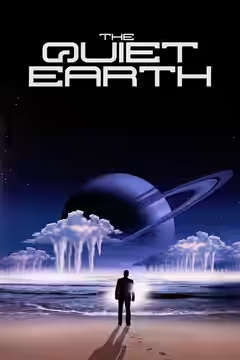
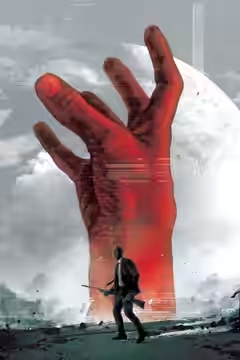
A lone man stands on a beach beneath an enormous ringed planet in the sky
Film review

The Quiet Earth

1985 · Directed by Geoff Murphy · 1h 31m · MPA R

In a sentenceGiven the whole planet, he has moved into a mansion and started shouting at cardboard Hitler within a week

Zac Hobson (Bruno Lawrence), a scientist, wakes in a motel room in New Zealand at twelve minutes past six one morning and finds that everybody has gone. Not dead: gone. A lorry sits idling in the road, a petrol station stands unattended, and a radio hisses on every band. He drives into the city, broadcasts a message asking anyone left to come and find him, and goes back to the laboratory where he worked on a project he begins to suspect has something to do with it. He moves into a large house on a hill, and, with nobody to answer to, starts to come apart. Then he meets Joanne (Alison Routledge), and later Api (Pete Smith), and each has a story about the morning it happened.

Plays from YouTube when you press play; nothing loads from them until then.

Fi1m review

Geoff Murphy’s New Zealand film about a scientist who wakes to find everyone gone is at its best when Bruno Lawrence has the planet to himself. Once other people arrive it turns smaller and more ordinary, then closes on an image we have not forgotten.

Zac Hobson (Bruno Lawrence) wakes in a motel room at twelve minutes past six and the world has emptied. Geoff Murphy’s film, adapted from Craig Harrison’s novel by Sam Pillsbury, Bill Baer and Lawrence himself, spends its first half hour on one man alone in New Zealand, and that half hour is as good as anything the last-man genre has produced. The rest is a good film, with two more people in it and a smaller idea, and it closes on an image that has stayed with us for weeks. We recommend it, and we recommend paying closest attention early.

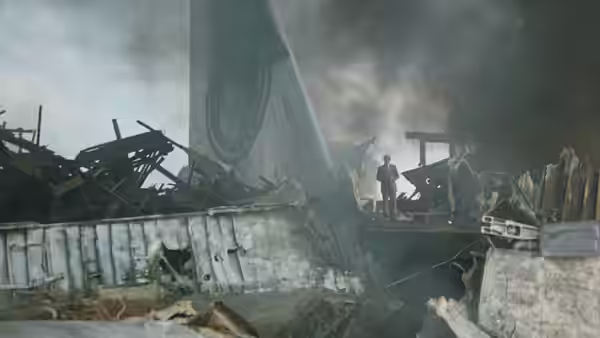
Murphy and his cinematographer James Bartle shoot the emptiness plainly. Wide streets in flat morning light, a petrol station with nobody at the pumps, a lorry idling in the road, and Zac walking through it in a suit calling out. There is no trick photography and there does not need to be; the effect is made by keeping the frame wide and letting nothing move in it. We were unnerved in a way we had not expected from a film this old, and it was the sound that did it. Murphy strips it down to footsteps, wind, a radio hissing on every band, and John Charles’s score, which arrives in low electronic tones and leaves again before it can become comforting.

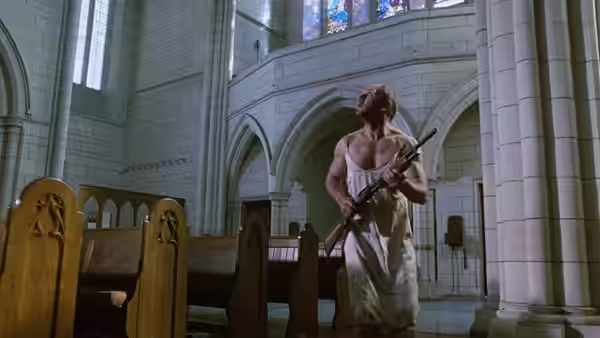
Zac does what a person actually might. He drives into the city and puts out a broadcast asking anyone left to find him. He goes back to the laboratory where he worked on a project he begins to suspect is responsible. Then he moves into a large house on a hill, puts on a woman’s slip, sets up cardboard cutouts of the great and the terrible on the lawn and addresses them from the balcony as president of this quiet earth. Later he takes a shotgun into a church and gives God a deadline. It is funny and then it is not, and Lawrence manages the turn without ever signalling it. He plays Zac as a tidy, reasonable, slightly pompous man whose reason is a thin coat, and he lets us watch it wear through.

Michael J. Horton cuts this section with real economy: a scene runs until the point has been made and no further, which is why 91 minutes feels shorter than it is. Josephine Ford’s production design gives the mansion the look of money, with polished floors and stopped clocks, and gives the laboratory a grey institutional dullness that makes Zac’s guilt about the place seem reasonable. Michael Kane’s costumes carry a good deal of the comedy, the slip and the borrowed finery Zac picks up as his sense of occasion grows.

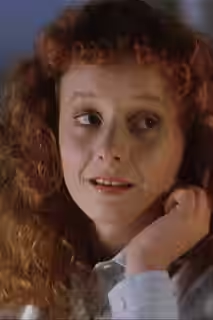
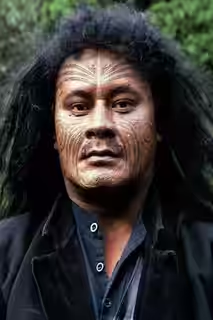
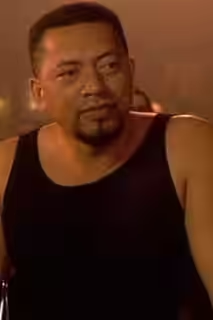
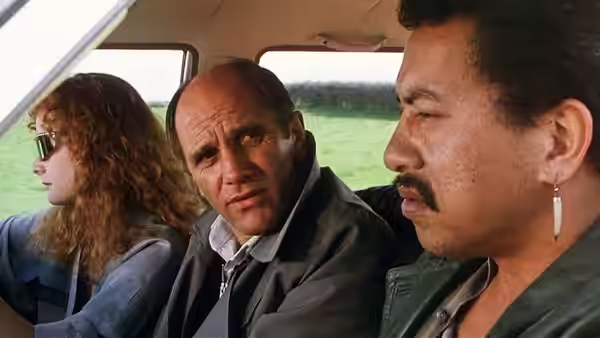
Then Joanne (Alison Routledge) arrives, and later Api (Pete Smith), and the film becomes a triangle. This is where most of the critics’ reservations sit, and ours sit there too. Routledge is good, sharper and steadier than the writing gives her credit for, and Smith brings a wariness to Api that the film needs. But the three-hander is ordinary in a way the solo section never is. The jealousies are the ones you would predict, the arguments arrive on schedule, and the question of what happened to everyone else, which the film has kept alive so carefully, is set aside for stretches while people sulk in separate rooms. The cast list is six names long and three of them barely register.

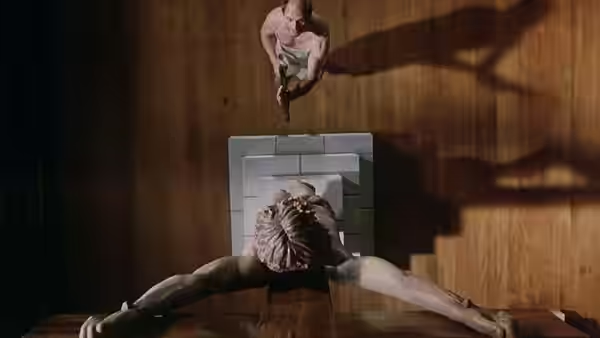
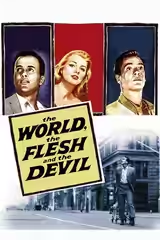
The last-man film has a long history, from The World, the Flesh and the Devil in 1959 to The Omega Man in 1971, and nearly all of them make the same move: the solitude is the interesting part and the arrival of other people is the plot. Murphy knows this. What he adds is an explanation clever enough to bear thinking about, and a final image, which we will not describe, that is the reason the film is still discussed. It sent us back to the beginning to check what we had missed.

It is a 15 certificate for the shotgun and the slip, and neither will trouble anyone much. Watch it alone, if you can arrange it. The house will feel larger afterwards.

Critical consensus AI synthesised

75
Positive
5
Mixed
2
Negative
0

Most critics are favourable, and the praise gathers around the same things: an imaginative premise, a refusal to explain itself, and Bruno Lawrence. Reviewers call his performance commanding and understated, sympathetic without asking for sympathy, and several credit him with keeping a human face on what could have been a cold exercise. Geoff Murphy’s eye is singled out, as is the economy of the long stretch in which Lawrence has the screen to himself. Alison Routledge is praised for the intelligence and strength she brings when she arrives.

Reservations are scarce. Nobody dismisses the film and the spread is narrow. Where critics differ is in how they read the close: Little White Lies and The Skinny both admire its ambiguity, treating the late turn as a door left open rather than an answer, while others settle for calling it haunting. Two of the reviews, from Time Out and The New York Times, are harder to place and offer no clear verdict, but neither counts against it.

Los Angeles Times
18 October 1985 · SHEILA BENSON
80*

Benson finds the film thoughtful and deeply felt, with a triumphant vision that leaves its meaning open to viewers. She especially praises Bruno Lawrence’s commanding performance and Geoff Murphy’s acute visual sense.

Read the full review →
Variety
31 December 1984 · Variety Staff
80*

The review finds the film imaginative and refreshing, with an intriguing mystical dimension. It especially praises Alison Routledge for bringing intelligence and strength to her role.

Read the full review →
Little White Lies
· Anton Bitel
75*

Bitel gives the film a thoughtful, favorable reading of its post-apocalyptic premise and themes. He particularly praises the economy of the solitary-character section and the striking, ambiguous final image.

Read the full review →
The New York Times
28 March 1986
64*

The page could not be accessed, so the critic’s verdict cannot be established. No specific praise or complaint is available from the supplied page text.

Read the full review →
Time Out
· WH
64*

The page identifies this as a film review, but the review text is unavailable. No critic verdict or specific praise or complaint can be established from the accessible content.

Read the full review →
Eye for Film
17 June 2017 · festival review · Jennie Kermode
85*

Kermode finds the film a haunting, lyrical study of loneliness that remains compelling and builds tension effectively. She especially praises Bruno Lawrence’s understated, sympathetic performance and the film’s human focus.

Read the full review →

Straight answers AI written, from our review

Is The Quiet Earth worth watching?
The Quiet Earth is worth watching, and we scored it 78, chiefly for its first half hour of one man alone in an emptied New Zealand and for a closing image we have not forgotten. Once two more people arrive it becomes an ordinary triangle, so it suits viewers who value atmosphere and an idea over plot.
How long is The Quiet Earth, and what is it rated?
The Quiet Earth runs 1h 31m and is rated R by the MPA in the US. It is a drama and science fiction film.
Where can I watch The Quiet Earth in the US?
The Quiet Earth is streaming on The Roku Channel, Tubi and Amazon Prime Video in the US, and it is also available to rent from Amazon Prime Video and Apple TV from $2.99. Availability is checked daily; the links above go straight to each service.
How violent or frightening is The Quiet Earth, and is it suitable for children?
The Quiet Earth is a 15 certificate, and the film earns it with a shotgun and a scene of Bruno Lawrence in a woman's slip rather than with gore or sustained horror. It is unnerving rather than frightening, made so by silence and empty streets, and it is not for young children, though older teenagers should manage it easily.
How does The Quiet Earth compare to Utu?
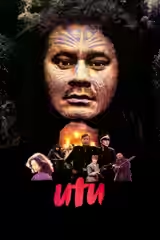
The Quiet Earth is a quieter, stranger film than Geoff Murphy's earlier Utu, which is a rough, bloody colonial revenge story about the New Zealand Land Wars. Both share Murphy's eye for landscape, but Utu struggles to hold its tone while The Quiet Earth falters only when its cast grows. Choose Utu for a war film, The Quiet Earth for solitude and an idea.
Is The Quiet Earth based on a true story or a book?
The Quiet Earth is based on a novel by Craig Harrison, adapted for the screen by Sam Pillsbury, Bill Baer and Bruno Lawrence, and it is not a true story. Our review does not say how faithful the adaptation is, and knowing the book is not needed; the film explains its own premise and rewards a second viewing on its own terms.
What should I watch after The Quiet Earth?
After The Quiet Earth, try Utu (1983, Fi1m 74): Murphy’s earlier film, a colonial revenge story with the same eye for landscape. Then Solaris (1972, Fi1m 87): Tarkovsky’s slow science fiction about guilt, memory and a place that answers back.

Cast

If you liked this, try…

  1. The World, the Flesh and the Devil (1959) · not on Fi1m yetHarry Belafonte alone in an empty Manhattan, until he is not; the template.

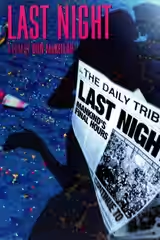
  2. Last Night (1998) · not on Fi1m yetToronto’s final evening on earth, told small and dry, with nobody rushing anywhere.

  3. Utu (1983, Fi1m 74)Murphy’s earlier film, a colonial revenge story with the same eye for landscape.

  4. Solaris (1972, Fi1m 87)Tarkovsky’s slow science fiction about guilt, memory and a place that answers back.

  5. Night of the Comet (1984) · not on Fi1m yetThe same empty world, treated as a lark by two Californian sisters.