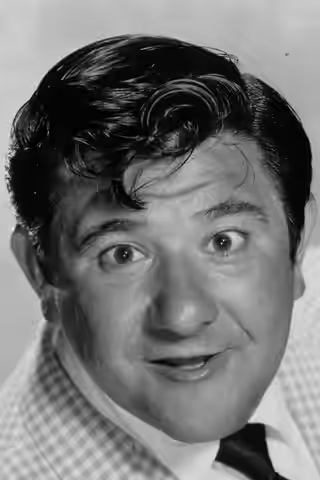
A Brooklyn nightclub comic who spent his film career playing the harmless friend in family pictures, Buddy Hackett was funnier than most of the parts he was given, and the gap between the act and the roles is the story.
Fi1m perspective
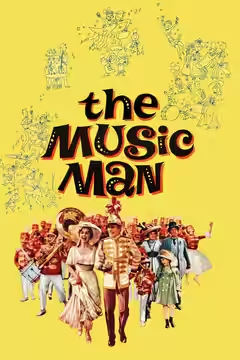
The first thing we notice about Buddy Hackett in The Music Man (1962) is the voice, which comes out of one side of his mouth as if it had been parked there. He plays Marcellus Washburn, the con man's former partner, who has gone straight and settled in the town Robert Preston's Harold Hill arrives to work over, and he spends most of the film being pleased to see him. Then he is handed "Shipoopi", a dance number about nothing, and the whole town joins in for six minutes while the story waits outside. We had been enjoying ourselves a quarter of an hour earlier, and we looked at the clock and were cross about it. That is the number's fault more than his; Hackett throws himself at it, and a man of his build throwing himself at anything is worth a look.
He had come up the hard way and the funny way. Stand-up in the Catskills resorts as a teenager, the army during the war, then the Brooklyn nightclubs, where he changed his name. Broadway noticed him in Lunatics and Lovers (1954), television gave him a sitcom, Stanley (1956–57), that did not last, and from the late 1950s he was in supporting film roles. The 1960s were the visible years: Benjy Benjamin in Stanley Kramer's It's a Mad, Mad, Mad, Mad World (1963), paired with Mickey Rooney, and Tennessee Steinmetz, the hippie mechanic, in Disney's The Love Bug (1968). After that the work was mostly voices, television guest spots and the clubs, and the voice that lasted was Scuttle the seagull in The Little Mermaid (1989), which he played again in the 2000 sequel.
The odd thing about the film career is how little of the act got into it. In the clubs and on the variety shows he was brash and blue, a heavy man with a thick New York accent saying things the network would rather he had not. The films took the shape and the face and left the material at the door, and cast him as the sidekick, the mechanic, the bird. He was at his best in crowds, where a big-cast farce could use his timing without asking him to carry anything, and stage fright kept him out of scripted theatre after Lunatics and Lovers, which may be why the films never asked him to carry one either. A seagull, on the other hand, can be as loud as he likes and nobody's parents mind.
So what survives on screen is a supporting player, and a good one, rather than the comedian people paid to see. Watch The Music Man for Preston and stay in your seat for "Shipoopi", because it is the closest the films came to letting Hackett off the leash, and he is still plainly on one. He once told Johnny Carson, "Did I mention that I was offered the job as the third Stooge once?" It would have suited him.
Biography
Buddy Hackett (born Leonard Hacker) was an American comedian and comic actor. Born in Brooklyn, New York, on 31 August 1924, he died in Malibu, California, on 30 June 2003.
He began performing in nightclubs and the Catskills resorts after military service in the Second World War. Hackett appeared regularly on television variety shows in the 1950s and 1960s, including The Jackie Gleason Show and The Tonight Show. His film roles include Marcellus Washburn in The Music Man (1962), Benjy Benjamin in It's a Mad, Mad, Mad, Mad World (1963), Tennessee Steinmetz in The Love Bug (1968), and the voice of Scuttle in The Little Mermaid (1989).