Carol Reed makes streets threatening and misplaced loyalty painfully understandable. We rate him highest when his care for actors matches his appetite for shadows, as it does in The Third Man, a thriller worth returning to.
Fi1m perspective
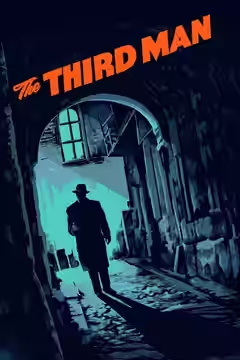
In The Third Man (1949), Holly Martins writes mysteries but cannot reliably judge the people in front of him. Joseph Cotten makes that failing human, and Reed keeps the enquiry moving without letting us forget how much Martins wants to believe in his friend. We worried about him because Cotten makes that loyalty understandable, even when it clouds his judgement. This is Reed at his most rewarding: a director who can make a thriller gripping without treating its people as a means of supplying the next clue.
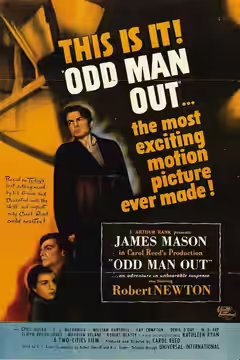
The route there runs through the social drama of The Stars Look Down (1939), the thriller Night Train to Munich (1940) and wartime documentary work, including co-directing The True Glory (1945). Odd Man Out (1947) begins the concentrated post-war stretch, followed by The Fallen Idol (1948) and The Third Man. The first brings documentary-influenced realism together with stylised images; the second makes room for Reed's sympathetic handling of child performance. It also begins his major collaboration with Graham Greene.
Greene's screenplay for The Third Man makes the investigation clear without making it easy, and editor Oswald Hafenrichter gives the actors time within it. Robert Krasker's tilted views and shadows make Vienna threatening, while Reed's location work among real rubble keeps it recognisable as somewhere people have to live. That combination matters more than any single clever angle. Some of the tilts draw attention to themselves before we notice the person in the shot, and a few relationships need more space. Yet the film remains worth returning to after the mystery has lost its novelty, because the question of what friendship excuses does not go away.
The later career is less consistent, with scripts sometimes failing him and commercial demands getting in the way. Dependence on good collaborators is a fair criticism, but we would still credit Reed for how well Greene's writing and Krasker's photography work together. The later Greene collaboration Our Man in Havana (1960) takes him towards lighter satire. Begin with The Third Man, and do not let anyone explain the mystery beforehand.
Biography
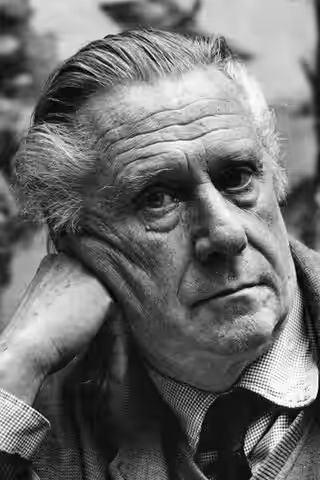
Carol Reed (30 December 1906 – 25 April 1976) was an English film director and producer. He began his career in the theatre before moving into film as a dialogue coach in the early 1930s and directing his first feature, Midshipman Easy, in 1935. He directed documentaries during the Second World War, including The True Glory (1945).
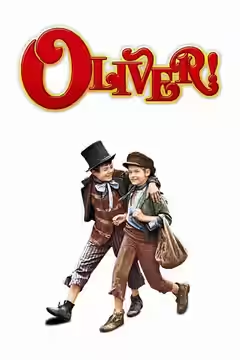
Reed achieved international recognition in the late 1940s with a series of films made in collaboration with writer Graham Greene: Odd Man Out (1947), The Fallen Idol (1948) and The Third Man (1949), on which he also served as producer. The Third Man won the Palme d'Or at Cannes. Later work included Our Man in Havana (1959), The Agony and the Ecstasy (1965) and the musical Oliver! (1968), for which he received the Academy Award for Best Director. He was the first British film director to be knighted.