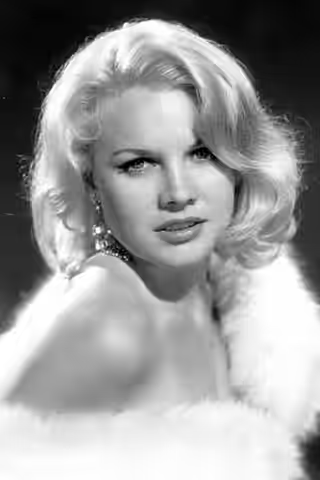
Carroll Baker was trained to play wanting, and Hollywood mostly asked her to be wanted. The two films we have reviewed give her a chapter and a subject rather than a part; the one that gave her a lead, Baby Doll, fixed her image.
Fi1m perspective
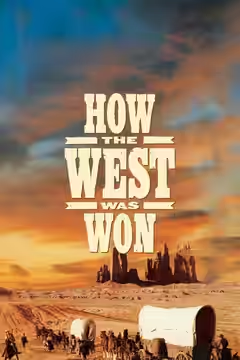
In How the West Was Won (1962), Carroll Baker's Eve Prescott looks at James Stewart's trapper and decides, more or less on sight, that she will marry him. Stewart is well into middle age, the film hopes we will not notice, and Baker has about a minute to make the wanting real before Henry Hathaway hands the story on to Debbie Reynolds and the wagon train. That was her position for much of her career. She trained at the Actors Studio under Lee Strasberg, where the feeling is meant to be built slowly and from underneath, and the pictures kept asking her to have it ready by the second reel.
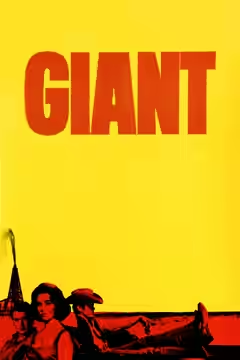
1956 was the year. Giant gave her Luz Benedict II, the rancher's daughter, in George Stevens's Texas saga, and Baby Doll, Elia Kazan's film of Tennessee Williams, gave her a lead and the image she carried afterwards. From then on she was cast, and seen, as a sex symbol, and The Carpetbaggers (1964) confirmed it. In between came the westerns: The Big Country (1958) for William Wyler, and two films with John Ford, whom she called Pappy and said she was grateful forever to have worked with. Contract disputes sent her to Europe in the late 1960s and 1970s; she came back to American supporting roles and television from the late 1970s, with Ironweed (1987) the one critics noticed, and stopped acting around 2003.
Neither of the films we have reviewed is a fair test, and we should say so. Giant is an hour too long, and the hour it did not need is the one she is in. The children grow up, Baker and Dennis Hopper and Sal Mineo arrive, and the screenplay hands each of them a topic to stand for instead of a person to be. We felt for her: the first ninety minutes had shown racism in a kitchen and in a doctor's refusal, and she is brought on to have it explained to her. How the West Was Won is more parade than film, and she is the float that goes past first. We were bored through most of her chapter, though the fault is Hathaway's pacing and a script that has Stewart's Linus and everyone else waiting for the next set piece.
What we can see in both is an actor doing the small, interior work the Actors Studio taught, in films built to be looked at from a distance. Cinerama does not reward a flicker across a face, and a five-chapter saga does not stop to watch one. The studio wanted a symbol and had hired a student of Strasberg, and neither side got over it.
It is a strange thing to be part of the reason a film is an hour too long and to have been given nothing to do in that hour. In Giant, Baker manages both, and none of it is her fault.
Biography
Carroll Baker is an American actress. She was born on 28 May 1931 in Johnstown, Pennsylvania. After studying under Lee Strasberg at the Actors Studio, she began performing on Broadway in 1954.
Baker made her film debut in a supporting role as Luz Benedict II in Giant (1956). She received an Academy Award nomination for Best Actress for her leading performance in Baby Doll (1956). Other early film roles include The Big Country (1958) and How the West Was Won (1962).
In the mid-1960s she appeared in The Carpetbaggers (1964) and Harlow (1965). Baker later worked in Europe, starring in several Italian giallo and horror films. She returned to American cinema with supporting roles in Star 80 (1983) and Kindergarten Cop (1990). She retired from acting in the early 2000s.