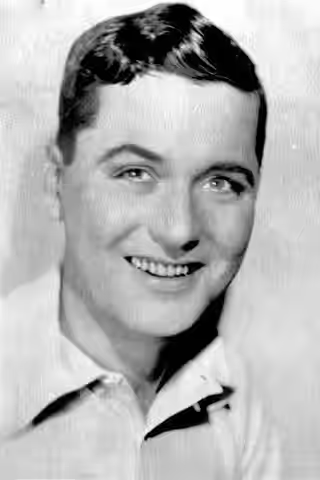
Charles King brought a Broadway voice to the first talking musicals and introduced songs that outlasted his name. The voice arrived on screen intact; the rest of the performer did not, and the camera noticed. Worth hearing once, not studying.
Fi1m perspective
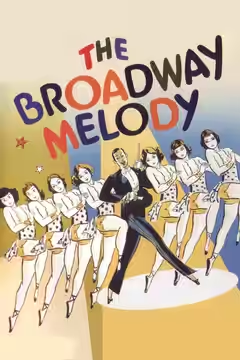
In a hotel room in The Broadway Melody (1929), Charles King sings 'You Were Meant for Me' to Anita Page. The tune is plain and pretty and the singing is honest. Then the song ends and he has to stand there, and he does not know what to do with his hands. That minute is the whole of King's film career: a voice built for the back row of a theatre, and a face the camera could find nothing to do with.
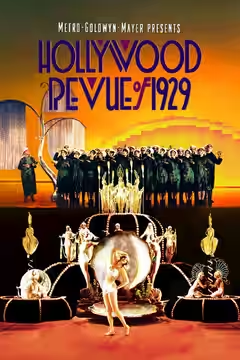
He came to Hollywood late in 1928 after twenty years on the stage, in revues from 1908, opposite Elizabeth Brice through the 1910s, and in the big musical comedies of the twenties, Hit the Deck (1927) and Present Arms among them. The studios wanted exactly that: people who could sing into a microphone without flinching, at the moment the microphone arrived. King was in the first all-talking musical and sang its title song. He was in The Hollywood Revue of 1929 the same year. In Chasing Rainbows (1930) he introduced 'Happy Days Are Here Again', which more people can hum than can name him. For about eighteen months he was what the new form sounded like.
What went wrong is visible in the one film of his we have reviewed. King plays Eddie Kearns, the song-and-dance man engaged to one sister and looking past her at the other, and he plays him at stage scale. The earnestness is real and it is aimed at the balcony. Bessie Love, in the same frames, has worked out that the camera can see a thought; King sells each line as if he still had to project it to the back wall. We felt for him in that hotel room more than the film meant us to. He is doing everything he was trained to do, and doing it correctly, and it is the wrong training. The camera in 1929 could not move, and neither could he.
The public tired of musicals almost as quickly as it had taken to them, and King's film work thinned through the early thirties. By 1935 he had gone back to the stage, where the equipment suited him. That is not a sad story. It is a man going back to the stage he was good on.
Watch The Broadway Melody for Love. Listen to it for King, and for the sound of a big theatre voice meeting a small microphone for the first time. He is not a screen actor. He is a record of the year before the screen learnt to look.
Biography
Charles King was an American actor who appeared in vaudeville, on Broadway and in films. He played Eddie Kearns in the 1929 MGM musical The Broadway Melody, the first all-talking film to win the Academy Award for Best Picture, and performed in other early sound musicals including Chasing Rainbows (1930).
Born in New York City, King had a stage career that included productions such as The Five O'Clock Girl (1928) before moving to Hollywood. He was married to Lila Rhodes from 1912 until his death. He died on 11 January 1944 in London while on a USO tour during the Second World War.