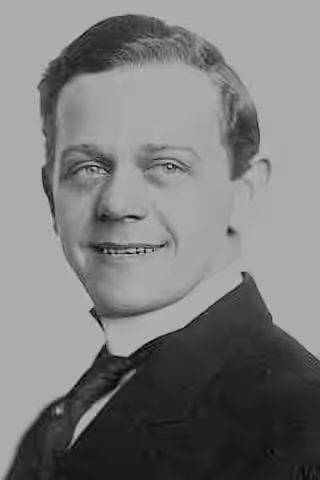
Charles Winninger played fathers the way other actors played villains: as a life's work. Bewildered, fussing, easily flattered and impossible to dislike, he made the parent the best thing in a run of films built around somebody younger.
Fi1m perspective
Watch Charles Winninger with an animal. In State Fair (1945) his Abel Frake fusses over Blue Boy in the pen the way a man fusses over a relative in hospital, checking his appetite, talking to him quietly, taking offence on his behalf. Nobody has told Abel this is funny, and Winninger does not tell us either. He played this sort of man for most of his time in pictures, the father at the edge of a story about somebody younger, and again and again he is the part of the film that holds.
He came to it late and from a long way off. He was a child in a family vaudeville troupe, made his Broadway debut in 1910, and in 1927 originated Cap'n Andy Hawks in Show Boat, a part he played again in the 1932 revival and the 1936 film, and which fixed the public's idea of him as the jovial riverboat captain for good. Sound films took him in the early 1930s as a character actor in comedies and musicals. He was Deanna Durbin's father three times and Judy Garland's twice, and he was the sheriff Washington Dimsdale in Destry Rides Again (1939). His only lead came in 1953, for John Ford, as Judge Priest in The Sun Shines Bright; his last film was in 1960.
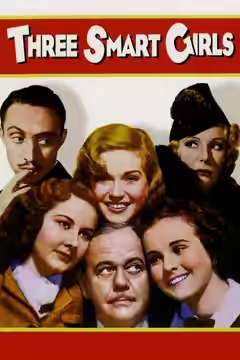
He does not play for sympathy. In Three Smart Girls (1936), Henry Koster's first American film, Judson Craig is a fool who has not noticed he is one, bewildered by his own daughters and flattered by his fiancée, and Winninger keeps him funny without letting him become pitiable. The vaudeville shows in the timing; he gets his laughs on the reaction, not the line. We went in expecting to watch Durbin, who was fourteen and the reason the film exists, and found we had spent half our attention on her father, because every time the plot creaked he was the one on screen behaving like a person.
He is best with a partner who sees through him. Fay Bainter's Melissa in State Fair watches her husband with a patience that has plainly lasted thirty years, and Winninger's fussing is funnier for being watched. Alice Brady does the same job from the other side in Three Smart Girls, as a woman who has done the arithmetic on Judson Craig. The limit is that he is always the same man, and the films around him are often thin; both of ours are sunny and slight, one of them directed without much curiosity, and he is the reliable thing in them rather than the surprising one.
Start with Three Smart Girls, then State Fair, in the afternoon, where it belongs. Do not expect him to change. Expect him, in nearly every film, to be the person you would rather have sat next to.
Biography
Charles Winninger was an American stage and film actor. He began his career in vaudeville and made his Broadway debut in 1910. His most prominent stage role was as Cap'n Andy Hawks in the original 1927 production of Show Boat, which he reprised in the 1932 revival and the 1936 film adaptation.
In films he appeared in Night Nurse (1931), Nothing Sacred (1937), Destry Rides Again (1939), Babes in Arms (1939), Ziegfeld Girl (1941) and State Fair (1945) as Abel Frake. He received a star on the Hollywood Walk of Fame in 1960 for his radio work. Winninger died on 27 January 1969.