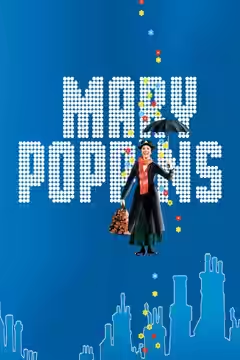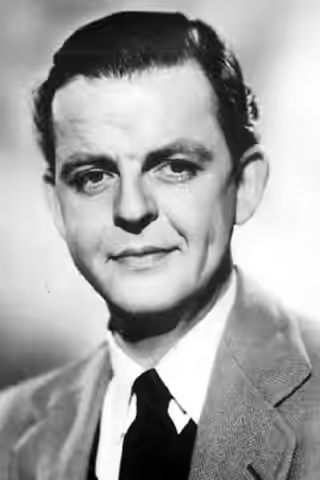
David Tomlinson played the English upper-class fool for the best part of forty years, flustered, long-faced and a step behind events. In Mary Poppins (1964) he found the one film that took the fool seriously, and we rate it highly.
Fi1m perspective
Watch David Tomlinson's face while other people are talking. The features are lugubrious and the expression is one of permanent perplexity, the look of a man who suspects the world has moved on without telling him. He built a career on that face. He rarely needed the joke to be in the line; he could stand at the edge of a scene and let the perplexity do the work.
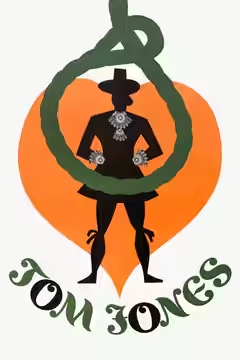
For twenty years the British cinema used him as its resident upper-class idiot. He began on stage and screen in the early 1940s, with RAF service in the middle of it, and spent the 1950s in comedies and supporting parts: light relief in the prisoner-of-war drama The Wooden Horse (1950), the lead of Three Men in a Boat (1956) as a genial twit on the river. He was Lord Fellamar in Tom Jones (1963), one of the pieces of Fielding's plot that Tony Richardson's film has to stop and explain once it reaches London, which is where we found it running out of puff. None of this is bad. Most of it is a man doing one thing well in films that asked for nothing more.
Then Walt Disney saw him on stage and cast him as Mr Banks in Mary Poppins (1964), and the fool was given a house and two children and something to lose. Tomlinson plays Banks as frightened rather than cruel, a man who has mistaken a tidy home and a steady job for looking after his family, and Robert Stevenson gives him the film's real story while Julie Andrews and the Sherman brothers have the songs. He is the reason the film is quietly about a father. When his turn comes in the second half, which we will not describe, we were moved more than we expected to be, and it was the face that did it: the perplexity going out of it and something plainer taking its place. Tomlinson later said of his own first opinion of the picture, "I was wrong about that one." So he was.
Disney kept him. He was the villain of The Love Bug (1968) and the friendly con-man Emelius Browne in Bedknobs and Broomsticks (1971), again for Stevenson, and our review of Mary Poppins says what that reunion showed: without Andrews the mixture is pleasant, and gone by breakfast. He retired from the screen around 1980. The criticisms that follow him are fair. The parts were narrow, the twit went out of fashion in the 1960s, and his reputation now rests on a handful of family films while the earlier British work has faded from view. We would only add that one Mr Banks is more than most actors get.
Start with Mary Poppins, and watch him rather than the umbrella.
Biography
David Tomlinson was an English actor. Born David Cecil MacAlister Tomlinson on 7 May 1917 in Henley-on-Thames, Oxfordshire, he died on 24 June 2000.
He appeared in numerous British films from the 1940s onwards, including Tom Jones (1963) as Lord Fellamar. He is also known for his roles as George Banks in Mary Poppins (1964), Peter Thorndyke in The Love Bug (1968) and Emelius Browne in Bedknobs and Broomsticks (1971).
Tomlinson trained at Tonbridge School and began his career on stage after a brief period in the Grenadier Guards. He served in the Royal Air Force during the Second World War.