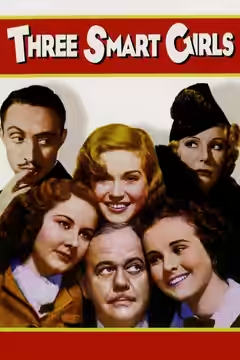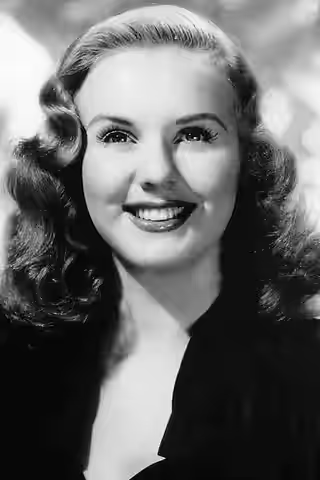
Deanna Durbin sang as if it cost her nothing and looked at whoever was nearest rather than at the lens, and Universal spent twelve years making much the same film around her. The ease is a pleasure; the repetition a waste.
Fi1m perspective
Fourteen years old, in a sailing boat on a Swiss lake, Deanna Durbin opens Three Smart Girls (1936) by singing, and the surprising thing is how little she makes of it. She does not lift her chin to the camera or open her arms. She looks at whoever is nearest, sings as though it costs her nothing, and stops when the song stops. We had braced ourselves for a child soprano in a 1936 comedy, and instead we sat back; it was the lack of fuss that did it. When she is not singing she is bossy, quick and impertinent, and the film has the sense to let her be a nuisance rather than a saint.
That was her first feature, made for the producer Joe Pasternak and directed by Henry Koster, both émigrés, and it made her a star at Universal. It also fixed the pattern. Pasternak produced ten of her films and Koster directed six, and in most of them she plays a plucky girl who puts helpless adults to rights through stubbornness and song: One Hundred Men and a Girl (1937), with Leopold Stokowski, and It Started with Eve (1941), opposite Charles Laughton, the last picture she made with both men. She had a clear lyric soprano and was handed popular songs and arias alike. The comedies suited her; she had timing, and she got on with her co-stars on screen.
The trouble is that Universal kept her fourteen. She grew up and the parts did not, and she said so: "I'm tired of playing little girls. I'm a woman now. I can't run around forever being the Little Miss Fix It who bursts into song." She tried to get out. Christmas Holiday (1944), for Robert Siodmak, put her in a dark drama; Lady on a Train (1945), directed by Charles David, tried mystery and comedy in the same film. We have not reviewed either, so we will not judge them here, but that they stand out as exceptions tells you how the studio saw her. In 1948, in her mid-twenties, she stopped acting, and she never came back.
What survives is the ease. She does not play to the back row, and that is why Three Smart Girls still feels like company rather than a recital, and why it is worth an evening. Start there. If the voice takes you, go on to the Koster comedies, and try not to spend the evening wondering what else she might have been allowed to do.
Biography
Deanna Durbin, born Edna Mae Durbin, was a Canadian-born actress and singer. She made her feature film debut as Penny Craig in Three Smart Girls (1936) for Universal Pictures, following a short with Judy Garland.
She starred in a series of successful musicals for the studio in the late 1930s and 1940s, including One Hundred Men and a Girl (1937) and It Started with Eve (1941). Her work was credited with helping Universal avoid bankruptcy, and she received a special Academy Juvenile Award in 1938, shared with Mickey Rooney.
Durbin retired from acting after For the Love of Mary (1948) and settled in France with her third husband, director Charles David.