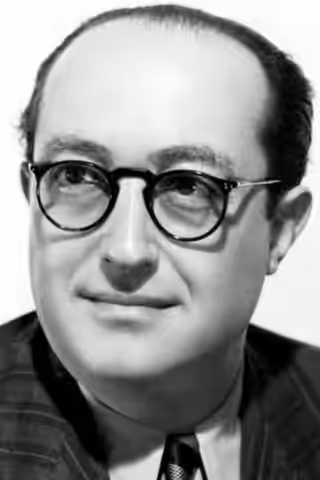
Henry Koster made films that do not look directed: family comedies and musicals in which the camera waits and the actors relax into being liked. With Deanna Durbin or James Stewart, that is a real skill. Later, the sweetness took over.
Fi1m perspective
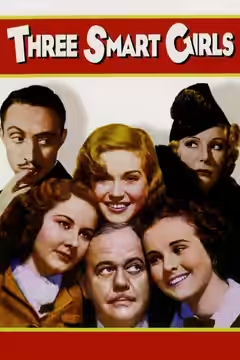
Nothing in a Henry Koster film tells you a director was there. The camera sits at a comfortable distance, the lighting is kind, and the scene belongs to whoever is talking, usually a young person with more sense than the adults around her. In Three Smart Girls (1936), his first American film, three sisters cross the Atlantic to stop their father marrying a woman half his age, and that plot is all there is. What Koster adds is patience. He puts Deanna Durbin, fourteen, in front of the camera and does not hurry her, and the film is pleasant because she is.
That was the method for thirty years, and it began somewhere else. Koster wrote scripts in Berlin from the mid-1920s and directed his first feature, Thea Roland, in 1932. He left Germany in 1933, worked in France and Hungary, and arrived in Hollywood in 1936 alongside the producer Joe Pasternak, with whom he would make eight films. At Universal the pair built a run of musicals around Durbin, six in all, starting with Three Smart Girls and One Hundred Men and a Girl (1937). Later he moved to MGM and Fox: The Bishop's Wife (1947), a Christmas fantasy; Harvey (1950), with James Stewart and a rabbit nobody else can see; and The Robe (1953), the first feature shot in CinemaScope. His last film was The Singing Nun in 1966.
Actors liked him, and it shows. "I found out that the best acting comes out of complete relaxation, not out of complete tension," he said, and his sets were known for it. Stewart made five films with him, and Harvey has lasted because Koster lets him take it at his own pace. We came to Three Smart Girls expecting to sit through a thin story politely and found we were smiling at the sisters for most of its 84 minutes, which is the whole of the trick: the company is good because nobody on screen looks as though they are working.
The cost is that there is not much else. Critics have long filed Koster as a reliable studio hand rather than a director with a signature, and the description is fair; his style is invisible by design, and invisibility is not a point of view. He liked, in his own words, stories "a little pixie-ish, a little fairytale-like", with a family feeling and a moral, often carried by a church or a concert hall. By the 1960s the reviews were finding that the sweetness had got the upper hand, and Flower Drum Song (1961) and The Singing Nun are the films most often held against him.
Start with the Durbin years, and stop some way short of the nuns.
Biography
Henry Koster, born Hermann Kosterlitz, was a German-born film director who worked in Europe and Hollywood. He was born on 1 May 1905 in Berlin and died on 21 September 1988 in Camarillo, California.
Koster directed his first film, the comedy Thea Roland, in Berlin in 1932. After leaving Germany in the early 1930s, he worked in France and Hungary before signing with Universal Pictures. His first American film, Three Smart Girls (1936), was a commercial success that helped revive the studio and launched a series of Deanna Durbin musicals.
Among his later credits are The Bishop's Wife (1947), Harvey (1950), No Highway in the Sky (1951), O. Henry's Full House (1952), My Cousin Rachel (1952), The Robe (1953), Désirée (1954) and The Story of Ruth (1960). He also directed Mr. Hobbs Takes a Vacation (1962) and The Inspector General (1949).