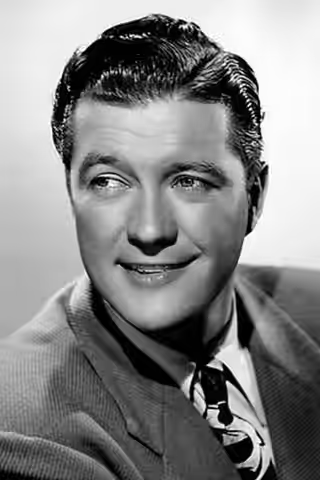
Dennis Morgan was Warner Bros' reliable nice man: a light tenor, an easy smile, and a habit of standing next to someone more interesting. He is pleasant company for ninety minutes, and pleasant is where it stops.
Fi1m perspective
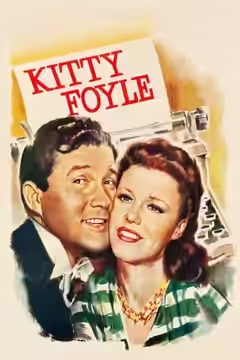
Wyn Strafford rings Kitty Foyle to say he is leaving for South America and there is a place on the boat if she can get to the pier by midnight, and Dennis Morgan plays it as if he were offering her a lift home. That is the Morgan manner. He is handsome, he is agreeable, he never raises his voice or his stakes, and the effect over a whole film is of a man who would like to be liked and has no further plans. In Kitty Foyle (1940) the part is a rich Philadelphia boy who cannot decide, and Morgan cannot find a way to make indecision interesting for 108 minutes. Ginger Rogers does the deciding for both of them.
The career took a while to settle on a name. He began in bit parts at MGM as Stanley Morner from 1936, moved to Paramount billed as Richard Stanley, and only became Dennis Morgan at Warner Bros, where his first substantial roles came in B pictures in 1939. Kitty Foyle got him leads. Through the 1940s he was a Warner leading man in musicals and comedies and the odd drama: The Desert Song (1943), Christmas in Connecticut (1945), Two Guys from Milwaukee (1946), My Wild Irish Rose (1947). When the contract ended in 1952 the work thinned to occasional film and television parts, and he kept at those until the late 1970s.
What worked was the voice and the company. The tenor is light and clean, and the musicals were built to let it out; The Desert Song and My Wild Irish Rose exist so that he can sing, and on the evidence of his reputation that was the right use of him. He was also better beside someone louder. Jack Carson made six films with him and Ann Sheridan three, and the buddy pictures with Carson gave Morgan a partner to be the calm one against, which is the thing he did best.
What did not work is the thing everyone noticed at the time and we noticed in 1940: he is likeable and he is not magnetic, and in a Warner picture that usually meant losing the girl to whoever was. The studio had a row of clean-cut young men on the payroll and he was one of them, and the parts were cut to fit the row rather than the man. By the time Kitty reached the pier we were no longer wondering whether she would choose him; we were wondering why she ever had, and nothing Morgan did in the Philadelphia scenes gave us an answer. He is charming in the way rich young men are charming when nobody has ever told them no, and the film needed him to be something more than that once.
Start with Kitty Foyle, and watch Rogers. The man on the telephone is better met in the musicals, where he was allowed to sing, and that is the best of him.
Biography
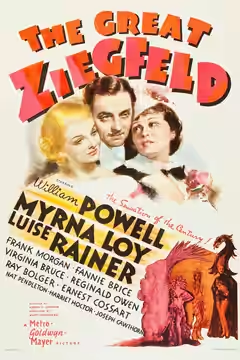
Dennis Morgan (born Earl Stanley Morner) was an American actor and singer. He began his film career under contract to MGM as Stanley Morner, appearing uncredited as the Stage Singer in the "Pretty Girl" Number in The Great Ziegfeld (1936). He was later billed as Richard Stanley at Paramount before signing with Warner Bros., where he was credited as Dennis Morgan and given leading roles.
His notable films include Kitty Foyle (1940), Christmas in Connecticut (1945) and several musicals and comedies made with Jack Carson. Morgan also appeared in The Return of Doctor X (1939) and In This Our Life (1942). After his Warner Bros. contract ended in 1952, he took guest roles in television series including Alfred Hitchcock Presents (1955), Petticoat Junction (1963) and The Love Boat (1977). His final screen work was in 1956.