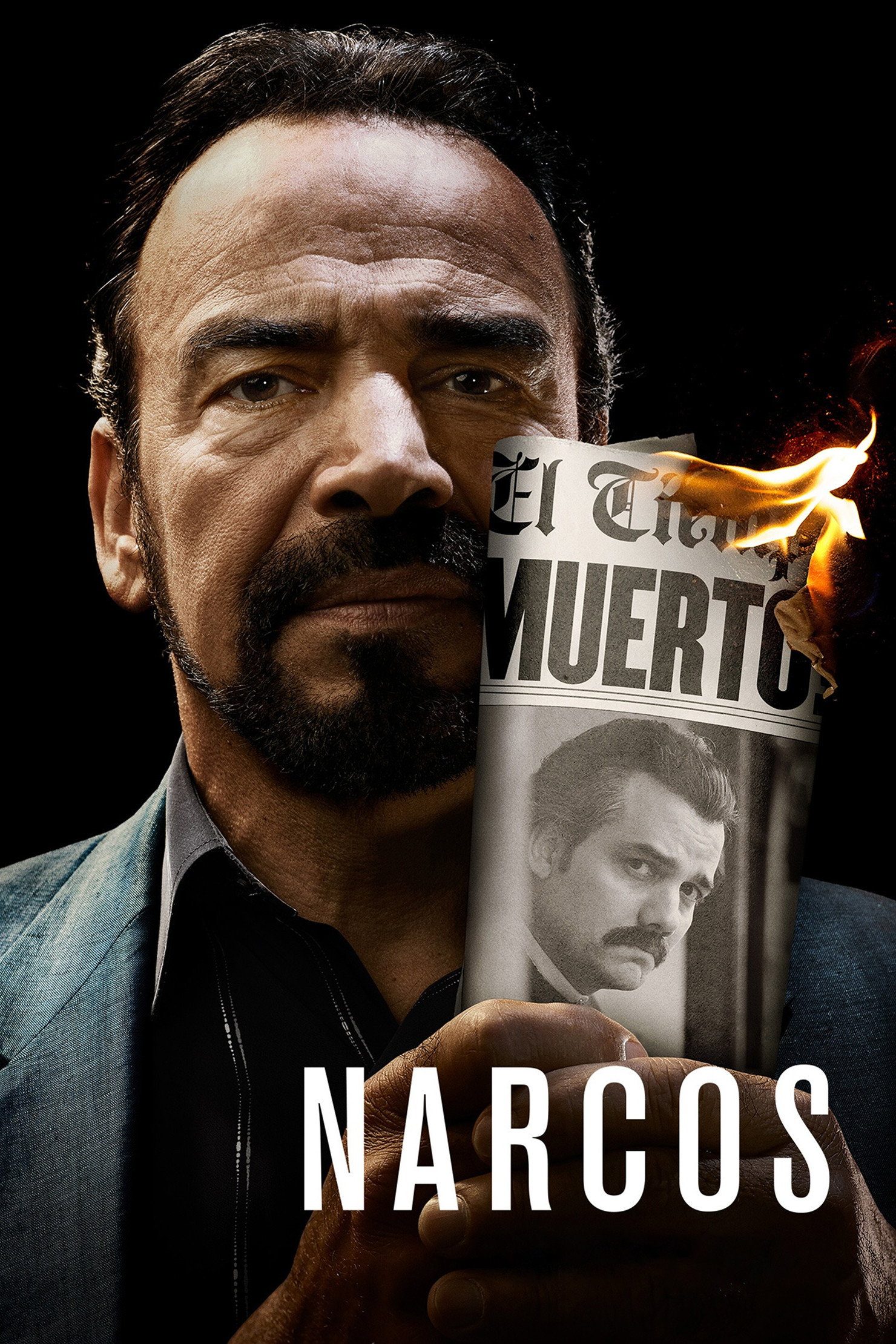
Doug Miro writes crime as history: real events, real footage, real names, and a narrator to make sure we have followed. In Narcos the method gives the drama a weight it would not otherwise have. The narrator is the price.
Fi1m perspective
Every few minutes in Narcos, the drama stops and the news starts. A face Wagner Moura has just invented is followed by the actual man, on the actual bulletin, in worse light. That cut is Doug Miro's signature, or as near as a writer in a room of three gets to one. He built the series with Chris Brancato and Carlo Bernard as three runs of ten episodes, beginning in Medellín at the end of the 1970s, and its whole claim is that this happened, in this order, to these people.
He came to it from the studios. For a decade he and Bernard, a writing partner since childhood, turned out large commissions together: The Great Raid (2005), The Uninvited (2009), Prince of Persia: The Sands of Time (2010), The Sorcerer's Apprentice (2010). Adaptation was the trade, a video game or a novel or a history reshaped into two hours with a chase in it. Then in 2015 Narcos arrived and he moved into television and stayed there: Narcos: Mexico (2018) followed, then Griselda (2024) with Ingrid Escajeda. The subject narrowed to the Latin American drug trade and the form widened to ten hours at a time. He has said he pitched Narcos as a 20-hour film, and the seasons play that way, one long action rather than ten small ones.
What the method gives is weight. Because the footage is real and the Spanish is spoken rather than translated away, Moura's soft-voiced Escobar sits inside the world instead of on top of it. We found the cut from Moura's face to Escobar's more unsettling each time it came, because the invented man is charming and the real one is not doing anything at all, and the series will not let us forget which is which. That is the best thing Miro and his colleagues did, and it is a writer's decision as much as an editor's.
What the method costs is the voice. An American narrator tells us what we have just watched, and the pictures did not need him. It is a writer's habit, the fear that history will not read as story unless somebody says so, and it is the one thing that kept Narcos from being better than good. By the third season the series had changed its subject and was running on habit, and the narration ran on with it.
Where he goes next looks settled: another cartel, another decade, another ten hours. We would like to see what he does without a narrator. The pictures in Narcos were carrying the story on their own, and the writer who assembled them ought to trust them.
Biography
Doug Miro is an American screenwriter and producer. He studied screenwriting at the USC School of Cinematic Arts and holds a degree in English from Stanford University.
Miro has written screenplays for several feature films, including The Great Raid (2005), The Uninvited (2009), Prince of Persia: The Sands of Time (2010), The Sorcerer's Apprentice (2010) and The Great Wall (2016), often in collaboration with Carlo Bernard. He is a creator of the Netflix series Narcos (2015) and Narcos: Mexico (2018), and co-creator of Griselda (2024).