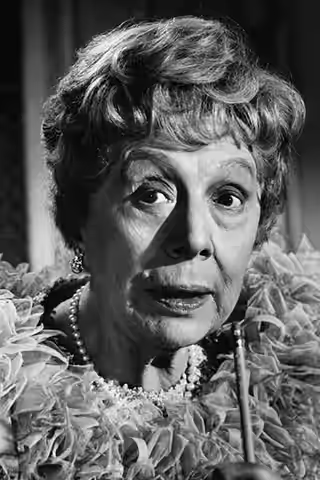
Edith Evans spent sixty years on the stage and came to film late, bringing a voice that could stretch two syllables into a verdict. Best in comedy, where every line lands exactly where she aims it; less sure when asked to fall apart.
Fi1m perspective
Two words. Lady Bracknell learns that the young man in front of her was found, as a baby, in a piece of luggage, and Edith Evans takes "A handbag?" and stretches it until the question stops being a question and becomes a verdict on the whole lower orders. It is the most famous thing she did on screen, in the 1952 The Importance of Being Earnest, and it shows how she worked. She did not act much with her face, and hardly at all with her body. She acted with the placing of a syllable.
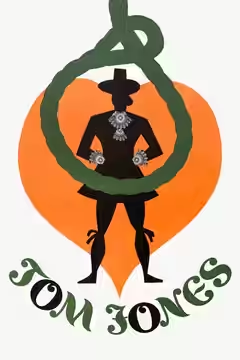
The screen got her late. She made her professional debut in 1912, as Cressida for William Poel, after an apprenticeship in a milliner's, and spent the following decades on the stage: Millamant in The Way of the World in 1924, the Nurse in Romeo and Juliet in an Old Vic season of 1925 to 1926, Shaw, more than a hundred parts across sixty years. Film hardly featured until she returned to it in 1948, and it is the run through the 1950s, 60s and 70s that most people now know: Bracknell, Miss Western in Tony Richardson's Tom Jones (1963), Mrs St Maugham in The Chalk Garden (1964), the lead in The Whisperers (1967). Richardson directed her twice.
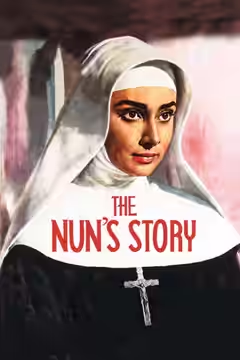
The one we have reviewed is the quietest. In Fred Zinnemann's The Nun's Story (1959) she is Reverend Mother Emmanuel, and she has perhaps four scenes. In each she tells Audrey Hepburn's young nun the terms of the life she has chosen, and she tells them as facts, not warnings: no threat in it, and no comfort either. We sat still through those scenes, and it was the flatness that did it. She gives the rules the same weight she would give the weather, and it is Hepburn's face, not hers, that has to register what they cost. A lesser actor would have played the Reverend Mother as an obstacle. Evans plays her as someone who went through the door years ago and is simply describing the other side.
Comedy is where she was safest. The Restoration and Wilde parts, Millamant and Bracknell above all, are the ones critics kept returning to, and the reason is timing: she could hold a pause past the point of comfort and release it on the right word. Tragedy came less easily. Some found her Cleopatra, in productions of the 1940s, less convincing, and we can see why: a voice built to make a rebuke ring is not the first thing you want from a woman coming apart. She knew which women she understood. "I know those sort of women," she said of preparing Bracknell. "They ring the bell and tell you to put a lump of coal on the fire."
Start with Bracknell, for the voice, then The Nun's Story, for what she could do when she put the voice away. The later films cast her as downtrodden or eccentric old women rather than dowagers, and she is worth following there, though the dowagers are the reason to come.
Biography
Dame Edith Mary Evans (1888–1976) was an English actress best known for her work on the British stage. She made her professional debut in 1912 and joined the Old Vic company in 1925, appearing in a range of classic and modern roles over several decades. She was appointed DBE in 1946.
Evans also appeared in films, particularly later in her career. Notable screen roles include Lady Bracknell in The Importance of Being Earnest (1952), Rev. Mother Emmanuel in The Nun's Story (1959), Miss Western in Tom Jones (1963), and the lead in The Whisperers (1967). She received three Academy Award nominations for her film work, as well as a BAFTA and a Golden Globe.