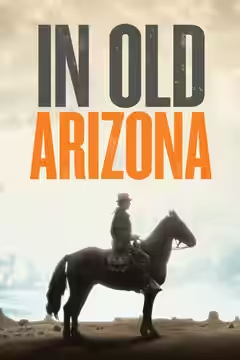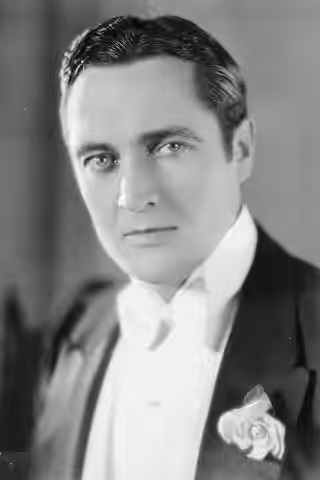
Edmund Lowe had a clear, deep voice and a brash, wisecracking manner, and as Sergeant Quirt in What Price Glory (1926) they made him. He was better in light parts than in heavy drama, and in In Old Arizona (1928) he shouts everything.
Fi1m perspective
In Old Arizona (1928) took its microphones outdoors for the first time, and the hooves, the cattle and the eggs frying in a pan are still the best things in it. Then Edmund Lowe arrives as Sergeant Mickey Dunn and shouts over all of them, as if the sound engineer were in the next county. We flinched the first time, and by the third scene we had started to feel for the crew. Warner Baxter, beside him, had worked out that the microphone was not a judge. Lowe was still playing to the gallery.
That is not surprising, given where he came from. He taught English and elocution before he went into vaudeville and on to Broadway, entered films in 1915, and was a leading man at Fox from 1923. The part that made him was Sergeant Harry Quirt in What Price Glory (1926), the loud, wisecracking rival to Victor McLaglen's Captain Flagg, and the pair made four films together. Quirt is the whole persona in one man: the clear, deep voice, the ready insult, the swagger that expects to be answered. Sound, when it came, gave him somewhere to put all that talk, and the salty pre-Code dialogue of the sequels suited him.
The 1930s put him in a tuxedo. He played detectives and reporters, confident and quick, and took his place among the stars of Dinner at Eight (1933) as Dr Wayne Talbot. The judgement on him that has held since is that he was better in lighter parts than in heavy drama, and not quite handsome enough for the very top rank. We would add, from In Old Arizona, that he was at his weakest when he trusted volume to do the work. From the mid-1930s the leads came from smaller studios, the move to Monogram being the usual marker of the slide, though Dillinger (1945), with Lowe as Specs Green, shows there was still a good supporting actor there. Television followed, including Front Page Detective (1951–53), and the last film was Heller in Pink Tights (1960).
In 1959 he told a newspaper that films were too long, that most stories could be told in ninety minutes, and that the epics of two and three hours were too hard on the audience. It is the only recorded opinion of his we have, and it is a good one. Start with What Price Glory, then In Old Arizona for the eggs, and take his advice about the running time.
Biography
Edmund Lowe was an American actor. He began his career in vaudeville and silent films from 1915, appearing in over 100 films. He is best remembered for his role as Sergeant Harry Quirt in What Price Glory (1926).
Lowe made a successful transition to sound films, playing Sergeant Mickey Dunn in In Old Arizona (1928). He later appeared in supporting roles in films including Dinner at Eight (1933), Around the World in 80 Days (1956), The Wings of Eagles (1957) and The Last Hurrah (1958). He also starred in the television series Front Page Detective (1951–52) and appeared in the first episode of Maverick (1957).
He attended Santa Clara University. Lowe was married to actress Lilyan Tashman from 1925 until her death in 1934. He died in 1971.