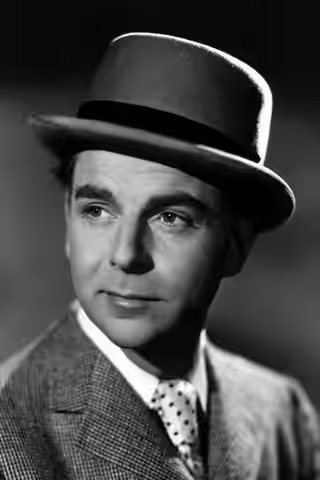
A playwright who acted, Emlyn Williams spent his screen career in other people's films and other people's supporting parts, and he made small ones count: a jester's patter, a face in a Welsh village. The big work was on the stage, and the films know it.
Fi1m perspective
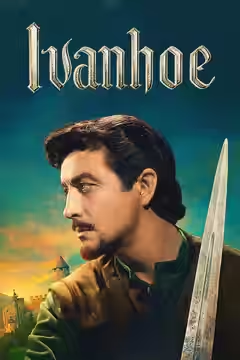
Watch Emlyn Williams's Wamba in Ivanhoe (1952). Richard Thorpe's film is a Saturday adventure with no patience for a fool, and Williams knows it, so he plays the jester as a music-hall turn, rattling the lines out before anyone can object and getting more of them to land than they deserve. It is the habit of a man who wrote lines for a living. He knows exactly how much weight a joke will carry and never asks it to carry more.
He was a playwright first. He began in London in 1927 writing and acting in his own plays, and the breakthrough was Night Must Fall (1935), in which he wrote himself a murderer and then played him. The Corn Is Green (1938) followed, a semi-autobiographical piece that went to Broadway and then to film. The screen took him in from the early 1930s, usually in support and usually, the casting directors having looked at him once, as the loyal companion or the put-upon working man.
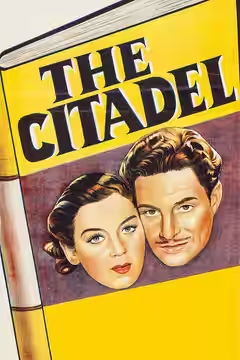
The Citadel (1938) is the better film and the better use of him. King Vidor's valley scenes belong to Robert Donat and Ralph Richardson, two clever men arguing about a sewer, and Williams's Owen, alongside Francis L. Sullivan's Ben Chenkin, does the humbler job of making the village look lived in rather than built. He also contributed dialogue to the film, and the valley is the part of it that talks like a place; London, later, talks like a sermon. We found that first hour more affecting than a film about public health had any right to be, and part of it is Williams, a Welshman himself, standing at the edge of the frame like a man who has lived on that street since birth. The film borrows his ease and does not give it back.
From 1952 he toured alone as Charles Dickens, reading the novels aloud, and it is the work for which he is best remembered. He worked twice with Alfred Hitchcock and gave Richard Burton his start. The one fair reservation anyone makes about him is that his best work was written rather than acted, and written for the stage. On film he is the man in the second row who makes the first row look real. Seek him out in The Citadel, and let Ivanhoe be the one you find him in by accident.
Biography
Emlyn Williams, born George Emlyn Williams, was a Welsh actor, dramatist and writer. He was born on 26 November 1905 in Mostyn, Flintshire, and died on 25 September 1987. Educated at Christ Church, Oxford, he began his stage career in the late 1920s and achieved success as a playwright with Night Must Fall (1935) and The Corn Is Green (1938).
Williams appeared in numerous films, including The Citadel (1938) as Owen, for which he also contributed additional dialogue, Jamaica Inn (1939) as Harry, Ivanhoe (1952) as Wamba, Another Man's Poison (1951) as Dr Henderson, The Wreck of the Mary Deare (1959) as Sir Wilfred Falcett, and The L-Shaped Room (1962) as Dr Weaver. He also wrote screenplays and directed The Last Days of Dolwyn (1949). He was appointed CBE in 1962 and became known for one-man stage shows portraying Charles Dickens.