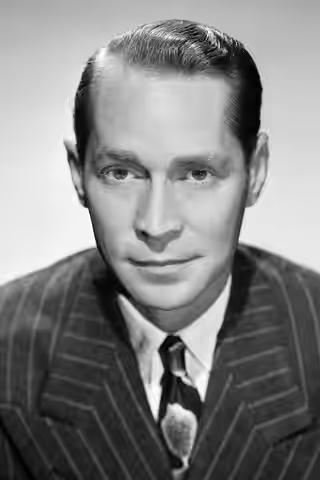
Franchot Tone played the man in the middle: the decent officer who dines with the captain and drinks with the mutineer and is believed by both. He did it without dullness, and Hollywood then spent a decade asking him for less.
Fi1m perspective
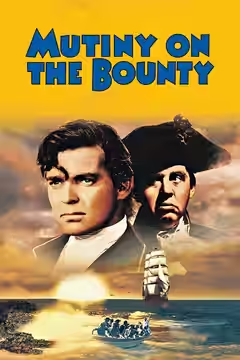
Watch Franchot Tone at Captain Bligh's table in Mutiny on the Bounty (1935). Charles Laughton has the lines and Clark Gable has the swagger, and Tone, as the midshipman Roger Byam, sent aboard by Joseph Banks to compile a Tahitian dictionary, has to sit between them and be believed. He dines with Bligh and drinks with Christian, and never once looks like a man choosing sides for the camera's benefit. We were more anxious for him than for anyone on deck, because he is the one man aboard sitting at both tables, and Tone plays the strain of that without asking us to notice it. It is the hardest part in the film and he makes it look like the easiest.
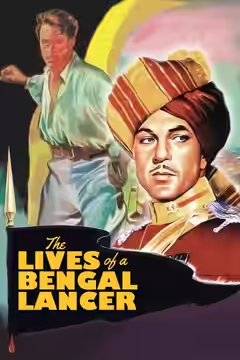
He came to pictures from the New York stage, where he had been a founding member of the Group Theatre, and MGM signed him in 1932. The studio saw a gentleman. Through the pre-Code years and the rest of the 1930s he was the sophisticate and the well-dressed playboy, opposite Joan Crawford seven times and Gable three. He was good at it, and it narrowed him: the parts were standardised, and the studio kept ordering the same one. The same year as the Bounty he made The Lives of a Bengal Lancer (1935), a quick-witted heroic turn he later called his own favourite, and that agreeable, ready manner is what MGM wanted more of.
He knew the problem. "I like picture work, but I can do better acting on the stage. There's more opportunity to create characterizations in a medium where one studies and rehearses a role for weeks. Pictures are made too rapidly for one to get a genuine understanding of the part one plays," he said in 1935, the year of his best-known film. It is not a complaint most leading men made out loud, and it explains Byam: a performance that looks rehearsed, in the good sense, in a film where Gable's Christian looks like a first take.
The leading roles thinned after the early 1940s. What came instead is, on paper, more interesting than the studio years: a wartime part for Billy Wilder in Five Graves to Cairo (1943), and Phantom Lady (1944), where he took a villain, which the playboy years had never allowed. By the 1950s he was in supporting parts, on television and back on the stage he preferred, and in Otto Preminger's Advise & Consent (1962) he played the President, the late authority-figure work that critics still notice. We have not reviewed these and will not pretend to have weighed them.
Start with the Bounty. Laughton will frighten you and Gable will amuse you, and both are meant to. Then look at the man between them, who is doing the quiet work of making the other two possible.
Biography
Franchot Tone was an American actor, producer and director. Born in Niagara Falls, New York, he studied at Cornell University and began his career on the stage, making his Broadway debut in the late 1920s.
Tone appeared in many films, most notably as Roger Byam in Mutiny on the Bounty (1935), for which he received an Academy Award nomination for Best Actor. He later played character roles in television series including The Twilight Zone (1959), Bonanza (1959) and The Alfred Hitchcock Hour (1962). He was awarded a star on the Hollywood Walk of Fame in 1960.