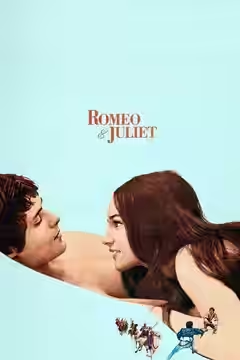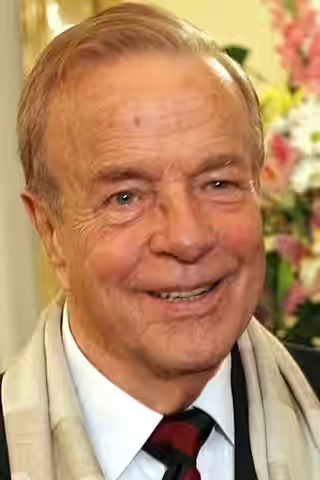
Zeffirelli filmed Shakespeare and opera as spectacle first: real Italian stone, heavy velvet, candles by the hundred and faces young enough to be rash. In Romeo and Juliet that is enough. Elsewhere, the decoration is often the whole idea.
Fi1m perspective
Halfway through Romeo and Juliet (1968) a boy sings a ballad about youth passing at a Capulet party, and Franco Zeffirelli does the simplest thing available to him: he cuts between two faces finding each other across a hall full of candles. Lorenzo Mongiardino built the hall in dark wood, Danilo Donati put the guests in reds and golds heavy enough to sweat in, and Nino Rota wrote the tune. We did not expect to be moved by a scene we have seen played a dozen ways, and we were, because Olivia Hussey plays it as a girl who has just learnt something about herself and Leonard Whiting as a boy who has forgotten everything else. That is the method in one scene: dress the hall until you can smell the wax, put young faces in front of it, and trust them.
He came to it from two directions. He began as a scene painter and assistant to Luchino Visconti on La Terra Trema (1948) and Senso (1954), and from Visconti he took the habit of shooting in real streets with real dust on them. Then he spent the 1950s directing stage and opera, including Shakespeare at the Old Vic from 1960, and from the opera house he took the rest: the scale, the velvet, the crowd. The Taming of the Shrew (1967), with Elizabeth Taylor and Richard Burton, was his first feature. Romeo and Juliet followed and made his name abroad, and after it came Brother Sun, Sister Moon (1972), the television Jesus of Nazareth (1977), a Hamlet (1990) with Mel Gibson and Tea with Mussolini (1999).
The idea in 1968 was the casting. He put teenagers in the leads because, as he said, "The teenagers of the play should be a lot like kids today... They don't want to get involved in their parents' hates and wars." Pasqualino De Santis, who shot two films with him, keeps the camera handheld and low in the opening brawl, so it plays as a riot rather than a fencing display, under light hard enough to make everyone squint. For an hour it is Shakespeare that moves like a film. Then the difficult scenes arrive and the verse pays for it: Whiting rushes the long speeches, Hussey leans on hers, the text has been cut too hard, and the second half slows to a crawl. Critics have said so since 1968 and they are right.
They have also said, of Brother Sun, Sister Moon and the opera films, that the decoration carries on after the thinking has stopped and the sentiment is laid on as thick as the candles. We have not reviewed those films and will not judge them here, but nothing in Romeo and Juliet argues against the charge. Zeffirelli believed a play could be made popular by making it beautiful and young, and he was often proved right, which is not the same as being proved deep. Watch the 1968 film for its first hour and its ball, and if the second half loses you, it lost us too.
Biography
Franco Zeffirelli, born Gian Franco Corsi Zeffirelli, was an Italian director of films, opera and theatre. He was born in Florence on 12 February 1923 and died in Rome on 15 June 2019. He studied at the Accademia di Belle Arti Firenze and the University of Florence, and worked as an actor and assistant director with Luchino Visconti before beginning his own career in the 1950s.
Zeffirelli directed the Shakespeare film adaptations The Taming of the Shrew (1967) and Romeo and Juliet (1968), the latter earning him an Academy Award nomination for Best Director; he also directed the television miniseries Jesus of Nazareth (1977) and the film Hamlet (1990). He served as a senator for the Forza Italia party from 1994 to 2001.
He was appointed a Grande Ufficiale OMRI in 1977 and received an honorary British knighthood (KBE) in 2004. He was awarded the Premio Colosseo by the city of Rome in 2009.