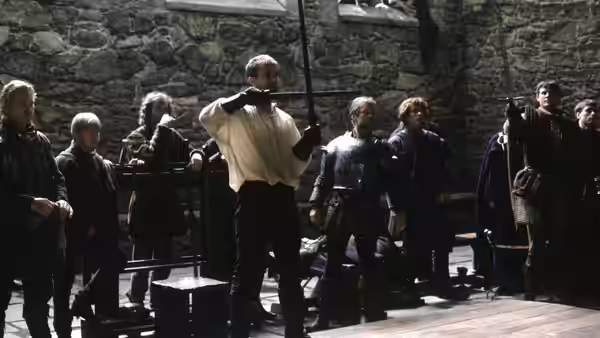
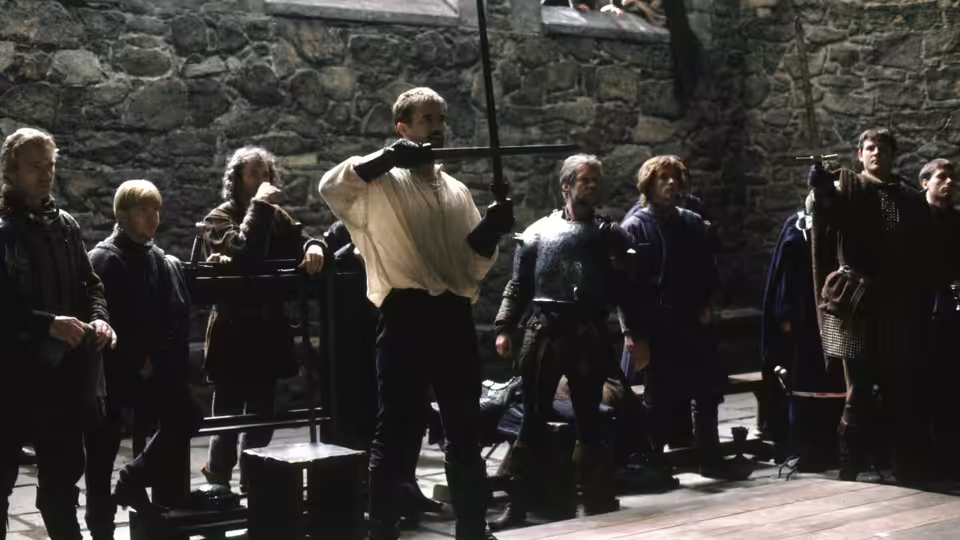
Hamlet (Mel Gibson) holds a sword among courtiers in a stone courtyard
Film review

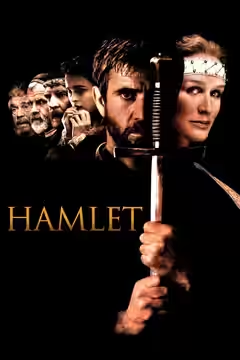
Hamlet

1990 · Directed by Franco Zeffirelli · 2h 10m · MPA PG

In a sentenceMel Gibson makes royal mourning look exhausting for everyone else

At Elsinore in Denmark, Hamlet (Mel Gibson) mourns his father while his mother, Gertrude (Glenn Close), settles into marriage with the dead king’s brother, Claudius (Alan Bates). Claudius now occupies the throne, and Hamlet cannot accept the family’s expectation that he should put his grief aside. The appearance of The Ghost (Paul Scofield) gives his anger a target: Claudius is accused of murdering Hamlet’s father, and Hamlet is called upon to take revenge. He wants to answer that demand, but the accused man is now king, with Gertrude at his side.

Fi1m review

Franco Zeffirelli’s Hamlet makes good, vigorous drama out of a family quarrel. Mel Gibson and Glenn Close give it feeling, although the prince’s doubts need more patience than this brisk adaptation allows.

Franco Zeffirelli’s Hamlet is good at making a royal family seem difficult to live with. It is a lively, accessible adaptation, worth seeing for the actors, though it gives the prince’s doubts less attention than his anger. The screenplay by Franco Zeffirelli and Christopher De Vore favours the immediate pressure of a quarrel, and the 130-minute running time suits that preference. Nobody seems to be waiting politely for the next celebrated speech, which is a useful beginning for Shakespeare on film.

Mel Gibson makes Hamlet’s resentment readily understandable: the grief is still raw, and everyone around him seems ready to get on with the new marriage. His physical impatience and flashes of humour give the part a welcome lack of ceremony, particularly when contempt interrupts the princely manners. We believe that this man could make an entire household wary of speaking to him. The limitation comes when he has to think aloud; too often the words sound like convictions already reached, and the effort of arriving at them is missing.

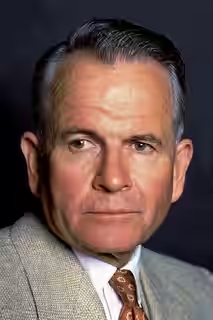
Glenn Close makes Gertrude harder to dismiss than a convenient cause of Hamlet’s distress. We were unexpectedly moved by her attempts at affection when Hamlet made his disgust plain. Glenn Close lets us see how much Gertrude wants to enjoy her marriage without alienating her son. Alan Bates gives Claudius enough ease to make Hamlet seem rude even when his anger is justified. Those family exchanges hold our attention without anyone having to announce how much is at stake.

Helena Bonham Carter’s Ophelia has a directness that helps make the pressure from those around her feel unpleasantly ordinary. Ian Holm finds the comedy in Polonius without making him seem harmless. Paul Scofield gives The Ghost a sorrowful authority, so the demand for revenge already feels burdensome. These performances keep the household interesting when Hamlet’s agitation becomes repetitive, and they give the film a range of responses to grief that the central performance cannot always supply.

David Watkin’s cinematography lets us study the faces without losing the sense of a court surrounding them. Dante Ferretti’s production design makes the court feel solid and inhabited, although the handsome surroundings occasionally offer too much relief from its unpleasant company. We can enjoy looking around when we ought to be anxious about who might be listening. That costs the film some of the unease its actors are working to create.

Richard Marden’s editing helps the arguments move, keeping exchanges from becoming a procession of individual recitals. That pace is less helpful when Hamlet has to hesitate, because we need time to feel why a decision is difficult. Ennio Morricone’s score gives the mourning a welcome gravity, although its solemnity sometimes fixes a feeling that ought to remain uncertain. The film repeatedly hurries past the point where a sentence might change the mind of the person speaking it.

Screen Shakespeare can grow stiff with its own sense of importance, and this version avoids that trap. Its actors are too combative to let reverence stop a scene, while the humour keeps the bitterness bearable. We miss the private, halting effort to work out what to do, which is a considerable loss in this particular play. For a first encounter with Hamlet, we would happily start here.

Critical consensus AI synthesised

64
Positive
2
Mixed
4
Negative
1

The recorded scores suggest a mixed reception for Zeffirelli’s Hamlet, with praise clustering around the performances. In the accessible reviews, Mel Gibson’s energetic, physical approach attracts approval even from critics with reservations about the adaptation. His humour also earns notice, while Helena Bonham Carter’s Ophelia and Glenn Close’s Gertrude receive individual praise. The favourable accounts value a vigorous, unfussy approach to Shakespeare rather than solemn reverence.

The division concerns how much that vigour achieves. Eye for Film finds Zeffirelli’s gamble successful, while Empire admires Gibson but finds the adaptation short on inspiration and audacity. The Los Angeles Times offers the sharpest objection: attractive images and creditable acting cannot compensate for coldness and the lack of a compelling interpretation. The scores span considerable enthusiasm to disappointment, but three review texts are unavailable, limiting how confidently their reasons can be included in the consensus.

Radio Times
★★★★ · David Parkinson
80

Parkinson finds Zeffirelli’s adaptation surprisingly vigorous and gives a positive verdict. He praises Mel Gibson’s performance as Hamlet and Helena Bonham Carter’s portrayal of Ophelia.

Read the full review →
The New York Times
19 December 1990 · Janet Maslin
65*

The New York Times page identifies this as a review of Zeffirelli’s Hamlet. The review text is inaccessible, so its verdict and specific praise or complaint cannot be established.

Read the full review →
RogerEbert.com
· Roger Ebert
64*

The page could not be accessed, so the critic’s verdict is unavailable. No praise or complaint can be reliably identified from the accessible text.

Read the full review →
Time Out
· SGr
64*

The page identifies a review, but its verdict cannot be determined from the available text. No specific praise or complaint is available to report.

Read the full review →
Empire
1 January 1990 · Angie Errigo
50*

Errigo finds the film a mixed bag that ultimately holds its own, though it may leave some viewers indifferent or sleepy. She praises Mel Gibson’s vigorous, humorous performance, while finding the adaptation short on inspiration and audacity.

Read the full review →
Los Angeles Times
19 December 1990 · MICHAEL WILMINGTON
40*

Wilmington finds the film visually lovely and Gibson creditable, but ultimately cold and lacking a compelling interpretation. He especially praises Glenn Close, whose Gertrude brings electrifying shame and desire to her scenes.

Read the full review →

Straight answers AI written, from our review

How long is Hamlet, and what is it rated?
Hamlet runs 2h 10m and is rated PG by the MPA in the US. It is a drama and history film.
Where can I watch Hamlet in the US?
Hamlet is streaming on The Roku Channel and Tubi in the US. Availability is checked daily; the links above go straight to each service.
What should I watch after Hamlet?
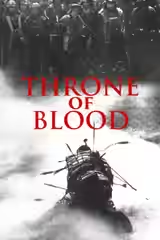
After Hamlet, try Chimes at Midnight (1965, Fi1m 88): Earthy Shakespeare and unruly company, with affection made painful by betrayal. Then Throne of Blood (1957, Fi1m 88): Royal ambition makes another household unsafe, with much less patience for talk; and The Lion in Winter (1968, Fi1m 81): A royal family argues with enough intelligence and spite to exhaust its kingdom.

Cast

Awards

Academy Awards, 1991

Nominated
Best Costume Design
Nominated
Best Production Design

If you liked this, try…

  1. Chimes at Midnight (1965, Fi1m 88)Earthy Shakespeare and unruly company, with affection made painful by betrayal.

  2. Throne of Blood (1957, Fi1m 88)Royal ambition makes another household unsafe, with much less patience for talk.

  3. Queen Margot (1994) · not reviewed yetRoyal marriages and family hostility turn another court into an unpleasant place to live.

  4. Richard III (1995) · not reviewed yetBrisk Shakespeare that gives political cruelty a sense of humour and a uniform.

  5. The Lion in Winter (1968, Fi1m 81)A royal family argues with enough intelligence and spite to exhaust its kingdom.

Free account

Know what to watch tonight

Two lists that know where things are streaming, collections you can share, your own score beside ours, and Discover that remembers what you have seen.

  • Want to see, sorted by what is streaming now
  • Seen, with your score out of ten
  • No adverts, ever