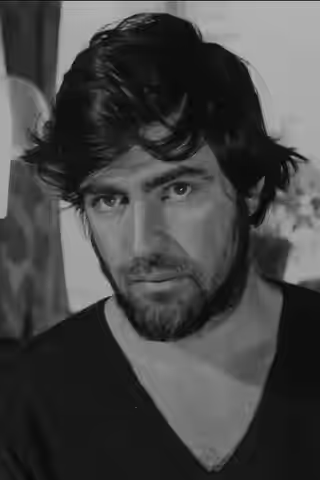
Alan Bates was the man at the table who was not talking. For a decade of British films he stood beside louder actors and listened, and the listening was the performance; the stage, and Simon Gray, let him make the noise himself.
Fi1m perspective
Watch what Alan Bates does with his face in Zorba the Greek (1964) while Anthony Quinn roars. He plays Basil, the buttoned-up Englishman who has come to Crete and spends two hours being told how to live. The part is a listening post, and Bates listens: a slight stiffening, a glance towards the door, the look of a man who has been handed a drink he did not ask for. It is small work and it is easy to miss, and the film needs somebody on screen to take Zorba seriously so that we are not obliged to.
That was his position for most of the 1960s. He came out of the Royal Court, where he was Cliff in Look Back in Anger in 1956, another quiet man beside a loud one, and made his film debut in The Entertainer (1960). Then the leads: Whistle Down the Wind (1961), A Kind of Loving (1962), Zorba, Far from the Madding Crowd (1967) as Gabriel Oak, The Fixer (1968) for John Frankenheimer, and Women in Love (1969), where Ken Russell gave him Rupert Birkin and, at last, the centre of the picture. John Schlesinger directed him three times in that stretch and seems to have understood that Bates read best when the camera stayed on him a beat after the other actor had finished.
The complaint, then and since, was that he receded. Put him next to something electric and he dimmed, and in Zorba we felt it: watching Quinn dance and Bates look faintly alarmed for the fourth time, we wanted the film to cut to him for a reason other than reaction, and it never did. That is partly the script, which gives Basil nothing to want. But it is also Bates, who never seemed to mind being the frame rather than the picture.
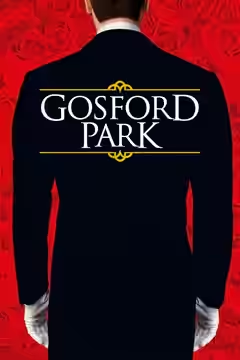
The stage let him out. He did six pieces of Simon Gray's, and Butley (1974), filmed from his stage performance, is the Bates the cinema rarely asked for: quick, bitter, funny, a man who has decided to talk everyone else out of the building. He worked with Harold Pinter twice. Late on there was Jennings in Robert Altman's Gosford Park (2001), a part in a very large cast that puts him back at the edge of the frame, where he was always comfortable.
He once said, "You can time a part any way you like, for effect. But you must always be honest." He kept to the second half of that. The first half he mostly left to whoever he was standing next to. Start with Women in Love, where he is the one doing the talking, and go back to Zorba afterwards to see how much he was holding in.
Biography
Alan Bates (1934–2003) was an English actor whose career spanned stage, film and television from the mid-1950s until his death. He trained at the Royal Academy of Dramatic Art and made his professional stage debut in 1955, gaining early recognition in John Osborne's Look Back in Anger (1956) with the English Stage Company at the Royal Court Theatre.
Bates came to prominence in the 1960s with film roles including Whistle Down the Wind (1961), A Kind of Loving (1962), Zorba the Greek (1964) as Basil, Georgy Girl (1966) and The Fixer (1968), the last of which earned him an Academy Award nomination for Best Actor. He continued to work across mediums, appearing in films such as Women in Love (1969), The Go-Between (1971) and Gosford Park (2001), and in television dramas including An Englishman Abroad (1983). He was appointed CBE in 1995 and knighted in 2003.