Film review

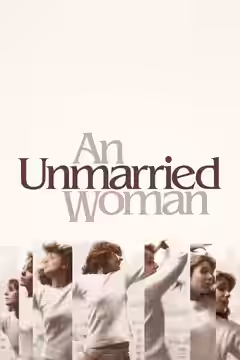
An Unmarried Woman

1978 · Directed by Paul Mazursky · 2h 04m · MPA R

In a sentenceThe husband cries on the pavement, the wife is sick in a bin, and the film only gets better from there

DramaRomanceComedy

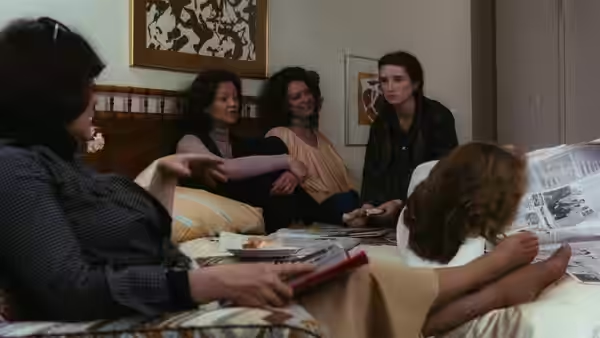
Manhattan, in winter. Erica Benton (Jill Clayburgh) has a husband, Martin (Michael Murphy), a teenage daughter, Patti (Lisa Lucas), and three friends who meet for lunch to talk about men: Elaine (Kelly Bishop), Sue (Pat Quinn) and Jeannette (Linda Miller). She jogs with Martin in the mornings and runs a household that appears to be working. Then, on a street corner after lunch, Martin bursts into tears and tells her he has fallen in love with another woman. He moves out. Erica has never lived on her own, and the rest of the film is her finding out what that costs and what it is worth.

Plays from YouTube when you press play; nothing loads from them until then.

Fi1m review

Paul Mazursky’s comedy about a Manhattan wife whose husband walks out is funny, exact and unusually honest about what a good marriage looks like from the inside. Jill Clayburgh carries it. A few scenes lecture where the rest of the film simply watches.

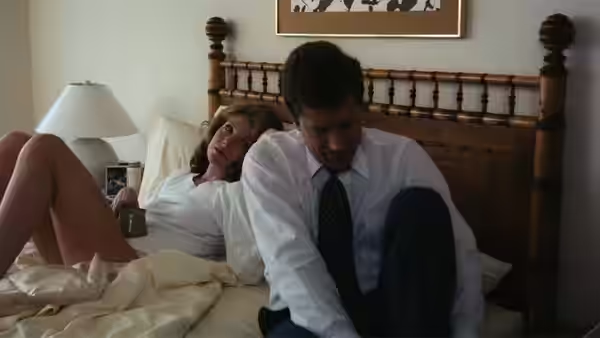
Paul Mazursky opens An Unmarried Woman on a marriage that is working. Erica and Martin Benton have sex before breakfast, jog together in the cold and argue about their daughter’s boyfriend, Phil (Matthew Arkin). Mazursky, who wrote the script as well as directing it, spends the best part of half an hour on this, and the time is well spent. By the time Martin (Michael Murphy) goes, we like him, and the film has no villain to lean on.

He goes on a pavement, in daylight, and it is the scene we thought about on the way home. Martin starts to cry before he has said anything, and Murphy plays him as a man who wants to be held while he explains that he is leaving. Erica listens, walks a few yards, and is sick into a litter bin. Arthur J. Ornitz keeps the camera among the passing strangers rather than cutting to a clean close-up, and editor Stuart H. Pappé stays on Clayburgh for longer than is comfortable. We watched it with a hand over our mouth. It is the most honest account of being left that we can remember in an American comedy, and it is over in about three minutes.

Jill Clayburgh carries the rest. She plays Erica as a woman who has been competent all her life and is now, for the first time, not sure of anything, and she does it without one speech asking for our sympathy. It matters that Mazursky shows her content before Martin has gone: we have seen her happy before the film asks whether she can be on her own. Lisa Lucas, as Patti, gives her a teenage daughter who is angry with the wrong parent, and their kitchen conversations are as good as anything here. Kelly Bishop, as the friend Elaine, gets the sharpest lines and delivers them from behind a glass.

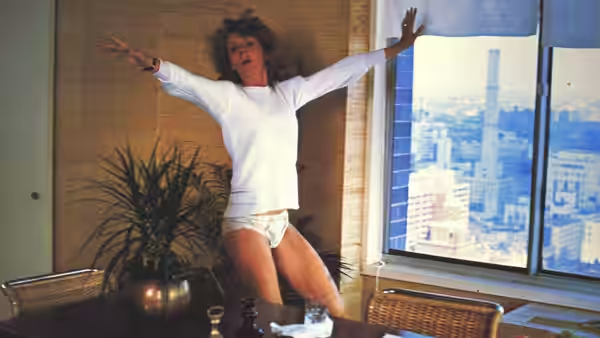
Ornitz shoots Manhattan in cold winter daylight, and the Benton flat, designed by Pato Guzman, looks like somewhere a comfortable Manhattan couple have lived for years rather than a set dressed for the week. Albert Wolsky dresses Erica in long coats, boots and camel and grey wool, so that when she does put on something else we notice. Bill Conti’s score follows her down the street, and it sounds like 1978 in a way we found we did not mind.

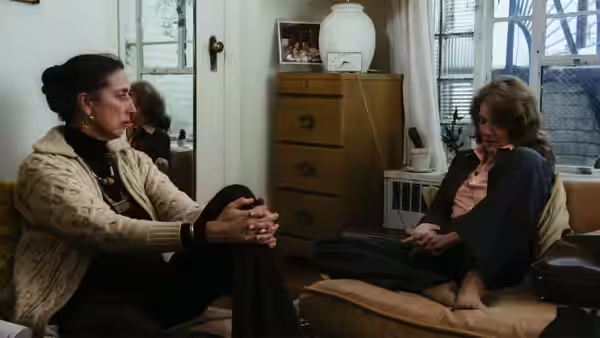
Not everything is watched so patiently. Erica’s sessions with her therapist, Tanya (Penelope Russianoff), are the film stopping to tell us what it has already shown, and Mazursky returns to them more often than the material needs. Cliff Gorman’s Charlie, a man who thinks frankness is the same as charm, is a good sketch, but he is there to be got wrong. And when Alan Bates arrives as Saul, an artist with a sense of humour, the film softens around him. Saul is the kind of man scripts invent for women who have earned one, and Bates is so likeable that we forgave it, mostly.

Mazursky had spent a decade on the comfortable American middle class, in Bob & Carol & Ted & Alice and Blume in Love, and this is the film where he stopped teasing them. The charge laid against it in 1978 was that it feels pleased with its own good sense. That is fair about the therapy scenes and unfair about everything else. Put it next to Kramer vs. Kramer, made a year later, which handed the divorce to the husband and was praised for it, and this one looks braver and less certain, which we take to be a compliment.

At 124 minutes it is a little long, and the last stretch could lose ten of them. The final scene we will not describe, except to say that it does not tie anything up and that we laughed out loud at it. Watch it with someone you have lived with for a long time, and do not talk over the first half hour.


Critical consensus AI synthesised

75
Positive
8
Mixed
1
Negative
0

Most critics like this film, and almost all of them for the same two reasons. Jill Clayburgh’s performance draws the warmest words: assured, sensitive, courageous, and in Film Comment’s view one of the great recent screen characters. Mazursky’s direction is credited with a sharp eye for New York detail and for letting his people roam, so that the politics of divorce and independence arrive through behaviour rather than speeches.

The reservations are about toughness. Writing on release, The New Yorker finds the film funny and buoyant but virtuous rather than properly critical, with too many liberation themes and some hot air. The New York Times, the one mixed notice, admires the performance and the sharpest scenes but thinks the whole is softer than they promise. The spread is narrow otherwise, and the later reviews are the warmer ones, with Collider in particular defending the open ending as confidence rather than evasion.

Film Comment
· Roger Ebert
90*

The critic calls it Mazursky's best film to date and one of the strongest recent American pictures, praising its precise observation, humor that cuts deep, and emotional release. He singles out Jill Clayburgh's courageous, revelatory performance as creating one of the great recent screen characters.

Read the full review →
Little White Lies
10 November 2019 · Nicole Davis
85*

The critic highlights the film's authentic depiction of a woman's multifaceted emotions and recovery process after divorce. Mazursky's fluid direction and camerawork underscore the ongoing, verb-like nature of becoming independent.

Read the full review →
Radio Times
★★★★ · Sue Heal
80

Jill Clayburgh delivers an assured and sensitive portrayal of a privileged Manhattan woman whose life unravels when her husband leaves. Mazursky shows a sharp eye for New York detail as her character inches toward feminism.

Read the full review →
Slant Magazine
25 June 2020 · Chuck Bowen
80*

Mazursky’s film is a lovely, poignant character study that dramatizes the rise of divorce and resulting liberation in the 1970s without preaching. The director allows characters to roam freely, finding politics in the wrinkles of human behavior and delivering unusually lived-in characterizations.

Read the full review →
The New Yorker
27 February 1978 · Pauline Kael
70*

The film makes a sensitive case for a modern woman's need for independence and is funny and buoyant, though it touches too many women's-liberation themes and has some hot air. Mazursky is deft but the picture feels virtuous rather than fully critical.

Read the full review →
Time Out
10 September 2012 · JS
70*

The film is very much a product of its New York setting and era, following a suddenly deserted wife who suffers yet moves toward a kind of feminism. The middle-aged characters are absurd yet perfectly believable.

Read the full review →

Cast

If you liked this, try…

Alice Doesn't Live Here Anymore poster

Alice Doesn't Live Here Anymore

1974 · Ellen Burstyn on the road with a child and no plan; funnier than it sounds.

Blume in Love poster

Blume in Love

1973 · Mazursky’s earlier divorce comedy, told from the side of the man who deserved it.

Gloria poster

Gloria

2013 · A divorced woman in Santiago goes dancing; Paulina García does what Clayburgh does here.

Shirley Valentine poster

Shirley Valentine

1989 · The Liverpool version: a wife talks to the wall, then leaves for Greece.

Scenes from a Marriage poster

Scenes from a Marriage

1973 · Bergman watches a marriage come apart at length, without jokes and without mercy.