Paul Mazursky made comedies about people who were doing fine until they weren't: marriages, affairs, divorces, all watched without a villain in sight. At his best, in An Unmarried Woman, nobody has done anything wrong and it still hurts.
Fi1m perspective
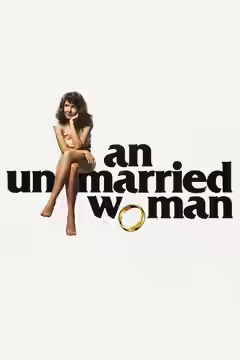
The first half hour of An Unmarried Woman (1978) is spent on a marriage that works. Erica and Martin Benton have sex before breakfast, jog together in the cold and argue about their daughter's boyfriend, and Paul Mazursky, who wrote it as well as directing it, is in no hurry to get to the part where Martin leaves. That is the habit that runs through his films. He shows you people who are content before he takes the contentment away, so that when it goes there is nobody to blame, and the film has to manage without a villain.
He came to directing by way of everything else. He began as an actor, in Stanley Kubrick's Fear and Desire (1953) among other early parts, and wrote television in the 1960s with Larry Tucker, including The Danny Kaye Show and the pilot of The Monkees. Bob & Carol & Ted & Alice (1969), which he co-wrote, was his first feature, a comedy about two couples working out what the new sexual rules allowed. Through the 1970s and 1980s he kept to the same ground: Harry and Tonto (1974), An Unmarried Woman, Moscow on the Hudson (1984), Down and Out in Beverly Hills (1986), Enemies, a Love Story (1989), most of them set in New York or Los Angeles, most of them comedies with something sadder underneath. Leon Capetanos wrote four of the scripts with him. He usually gave himself a small part.
What he did well was listen. The dialogue sounds overheard rather than written, and he got performances out of women that other directors of his generation did not seem to want. Jill Clayburgh's Erica has been competent all her life and is then, for the first time, unsure of everything, and she never once asks for our sympathy. We liked Michael Murphy's Martin by the time he walked out, which we did not expect and rather resented, and that is the point: Mazursky wants us to lose something along with her. He told Roger Ebert he did not have it in him to make a film in which everything was black and white, and the films bear him out.
What he did less well was trust the watching. The therapy scenes in An Unmarried Woman stop to say what the kitchen scenes have already shown, and when Alan Bates arrives as Saul, the artist with a sense of humour, the film goes soft around him. That softness was the charge laid against the later work, Scenes from a Mall (1991) and The Pickle (1993) among it, and the reviews for those were mixed. He directed less often after that, and made a documentary in 2006.
Start with An Unmarried Woman, then Bob & Carol & Ted & Alice, and watch for the director himself somewhere in the background, apparently having a better time than his characters.
Biography
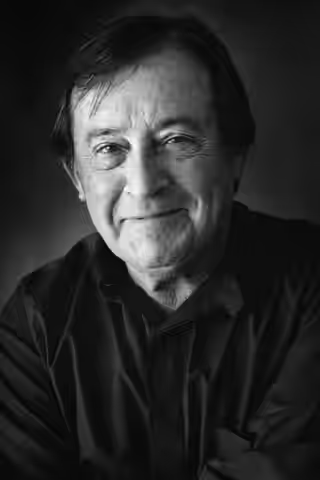
Paul Mazursky was an American film director, screenwriter and actor. Born in Brooklyn, New York, he began his career as an actor in the 1950s and later wrote for television before making his feature directorial debut with Bob & Carol & Ted & Alice (1969).
Mazursky directed, wrote and produced An Unmarried Woman (1978). He received five Academy Award nominations across his career, including for Bob & Carol & Ted & Alice (1969), Harry and Tonto (1974), An Unmarried Woman (1978) and Enemies, A Love Story (1989). Other films he directed include Next Stop, Greenwich Village (1976), Moscow on the Hudson (1984), Down and Out in Beverly Hills (1986), Moon over Parador (1988) and Scenes from a Mall (1991).
Mazursky died in Los Angeles on 30 June 2014.