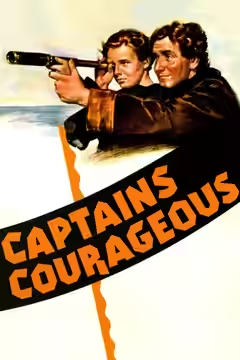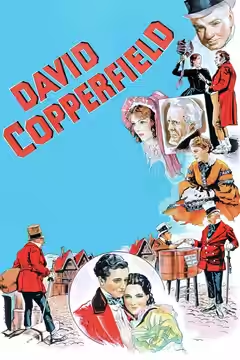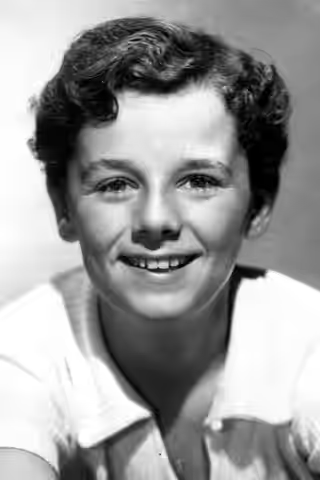
Freddie Bartholomew was the boy at the edge of the frame who listened, and for three years in the mid-1930s Hollywood built its literary adaptations around that listening. The stillness was real, and it did not survive his growing up.
Fi1m perspective
In George Cukor's David Copperfield (1935), Basil Rathbone's Murdstone stands in the parlour with a hand resting on Elizabeth Allan's shoulder, and the boy watching them says nothing. Bartholomew's David listens more than he speaks. Rathbone never raises his voice, and the beating that follows is played mostly on the boy's face and the door. We were frightened, and it was the child's face that did it rather than the man's: he understands what is coming a beat before we do, and he does not act out the understanding. There is not a trace of the stage child in him, which is the rarest thing a child actor can offer.
He had been performing since he was three and appearing in small British films from six, and Cukor and David O. Selznick brought him to Hollywood for Copperfield under a seven-year MGM contract. What followed was brief and concentrated. He was Garbo's son Sergei in Anna Karenina the same year, Cedric Erroll in Little Lord Fauntleroy (1936), the young Jonathan Blake in Lloyd's of London (1936) and Harvey Cheyne opposite Spencer Tracy in Captains Courageous (1937), which most critics still take as his best work. The pattern is plain: refined, curly-haired English boys with precise diction, placed beside established stars in costume dramas and adaptations. The studios had found a child who could hold a frame with adults in it, and they used him for that and little else.
The strength was the same each time. He could sustain a character across a lead role rather than deliver a party piece and vanish, and he played opposite grown actors as if he believed them. His own memory of Captains Courageous is telling: "For a kid, it was like one long outing. Spencer Tracy, Lionel Barrymore, Mickey Rooney, Melvyn Douglas and I – we all grew very close toward one another in those 12 months. When the shooting was finished, we cried like a bunch of babies as we said our goodbyes." That is how he appears on screen, a small person in a company of large ones, not the cute thing the camera has been pointed at. We have not reviewed those later films and will not weigh them here. But the limit of the gift is visible even in Copperfield: it is a boy's gift, built on watching and waiting, and it has no obvious adult form.
After 1937 the good parts thinned out, his popularity fell away as he became a teenager and tastes shifted, and after the war he went behind the camera, directing and producing for television before moving into advertising. He made four films with Mickey Rooney. If you want to know what the fuss was about, watch the first hour of David Copperfield. That is where he is, and he does not need the second.
Biography
Freddie Bartholomew was an English-American actor. Born Frederick Cecil Bartholomew in Harlesden, London, he trained at the Italia Conti Academy of Theatre Arts and appeared in minor British films before emigrating to the United States in 1934.
He became a star with his performance as the young title character in David Copperfield (1935). Other notable roles include Sergei in Anna Karenina (1935), the title character in Little Lord Fauntleroy (1936) and Harvey Cheyne in Captains Courageous (1937). After military service in the Second World War, during which he became an American citizen, his film career declined and he moved into television directing and producing before becoming an advertising executive.