Giles Foster is a television director of literary adaptations who trusts a good actor and a plain shot over anything louder. Silas Marner shows the method at its best, and also its cost: the people at the edges of the story get hurried.
Fi1m perspective
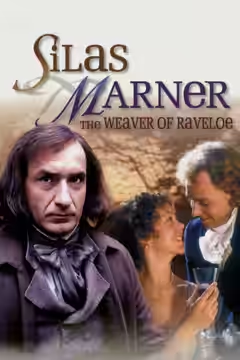
The moment that tells you what Giles Foster is for comes near the middle of Silas Marner (1985). Ben Kingsley's weaver has found his hiding place empty and stands with a brick in his hand, not understanding, and Foster leaves him there longer than most directors would allow. Nothing is added. No music, no cut to the door, no help. He has a good actor doing a true thing and he knows the right response is to wait.
That patience is the whole of his style, and it is a television style, built for the BBC single drama and for strands like Screen Two and Play for Today, where the budget is the cast and the script. Foster trained at the Royal College of Art and began directing television drama in the mid-1970s, and through the 1980s he worked almost entirely from novels: Eliot in Silas Marner, which he wrote with its producer Louis Marks, Anita Brookner in Hotel du Lac (1986), Austen in Northanger Abbey (1987). In 1988 he directed Alan Bennett monologues for Talking Heads, among them A Lady of Letters, which is about as close as a director gets to the pure case: one actor, one camera, and the decision of when not to move it.
What works is the stillness. Kingsley's Silas peers through a squint, carries his shoulders up by his ears and counts his coins with the fingers rather than the eyes, and the performance would be mannered if Foster had not kept the frame so calm around it. We liked that cottage more than we expected to, and it was the counting that did it: a small smile over gold, the only warmth in the cottage, and the camera content to let it be small. Nat Crosby shot two of his pieces and the plainness suits them.
What does not work is the clock. Ninety minutes is not long for a novel that covers decades, and Foster's answer was to give the weaver nearly all of it and the Cass family what was left. That is the right trade, since the weaver is Kingsley, but it means the other half of Eliot's book goes by in a hurry, and we suspect the same instinct, close on the one face, brisk with the rest, runs through the later work too.
The career after that is steady rather than surprising: Joanna Trollope in The Rector's Wife (1994), Alan Plater's Oliver's Travels (1995), Bertie and Elizabeth (2002), two episodes of Foyle's War (2003), and then Rosamunde Pilcher adaptations filmed in Germany and Australia. We have not seen enough of those to judge them. Start at the cottage; it is the clearest statement of what he does, and it takes an hour and a half.
Biography
Giles Foster is an English television director and writer. Born in June 1948 in Bath, Somerset, he was educated at Monkton Combe School and began directing for television in 1975, specialising in drama.
He directed and co-wrote the 1985 television adaptation of Silas Marner, directed episodes of Talking Heads (1988) and Play for Today, and has worked on series including Foyle's War and Tales of the Unexpected. Foster has also directed in Australia and Germany. He received BAFTA nominations for Silas Marner and Talking Heads, and won Best Single Drama for Hotel du Lac (1986).