Tristram Powell made television that trusted a face and a sentence to carry the hour, from Alan Bennett's monologues to Michael Palin's seaside memories, before a last decade on ITV crime. Gentle is the word, and it is not a small one.
Fi1m perspective
One actor, one room, and the writer there to watch. That was how Alan Bennett's Talking Heads monologues were made, in long single takes with Bennett present, and in 1988 Powell directed Stephanie Cole in 'Soldiering On' under exactly those conditions. Nowhere to cut, nowhere to hide, and a director whose main job was to stay out of the way of a face and a sentence. The phrase critics reached for when he was making arts documentaries in the 1970s was deceptively gentle, along with a sharp memory for the one image that could stand for a scene, and it is as good a description as any of what came after.
He came up through BBC arts programming, a production assistant in the mid-1960s and then a documentary director for Omnibus and Arena through the 1970s and into the 1980s. Drama came in the early 1980s, mostly literary adaptations and single plays. The Ghost Writer (1984) was Philip Roth, with Powell co-writing the script alongside the novelist; Roth, in the end, did not like the finished film. Then the Screen Two years: East of Ipswich (1987), Michael Palin's memories of 1950s seaside holidays, and the feature American Friends (1991), co-written with Palin and taken from his family diaries, which is the one cinema credit of any size.
The pattern is writers who put their own lives on the page and wanted a director who would not improve them. Bennett worked with him four times, Palin three, Andrew Davies twice, the last on Falling (2005), from the Elizabeth Jane Howard novel. What people consistently notice is a steady pace and a firm sense of where we are, and American Friends is the film usually named for both.
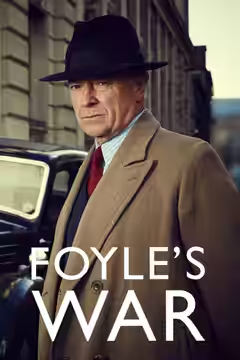
The last decade was ITV crime and law: Trial & Retribution, Kavanagh QC, Judge John Deed, Law & Order: UK until 2009, and three episodes of Foyle's War in 2007 and 2008, 'Casualties of War', 'Plan of Attack' and 'All Clear'. Foyle's War is the only title of his we have reviewed, and we should say plainly that the series had its manner long before he arrived and our review does not single him out. But we went to it expecting a comfortable Sunday evening and came away unsettled by how angry it is, under the good manners, about what the war let people get away with. Michael Kitchen underplays Foyle throughout, and the programme is better for every line he does not push. It is not hard to see why a director of monologues was asked.
The cost of a career like this is that the writer gets the credit. Nobody talks about a Tristram Powell shot, and he seems to have arranged it that way. Start with the Bennett, then East of Ipswich, and watch how much he lets the actors do.
Biography
Tristram Powell was an English television and film director, producer and screenwriter. Born in Oxford in 1940, he was educated at Eton College and Trinity College, Oxford. He began his career in arts documentaries and went on to direct drama for the BBC and other broadcasters.
His credits include the 1987 Screen Two film East of Ipswich, written by Michael Palin, episodes of Alan Bennett's Talking Heads (1988 and 1998), and episodes of Foyle's War (2007–8). He also directed the feature film American Friends (1991) and adaptations such as The Ghost Writer (1984) and Falling (2005). Powell died in 2024.