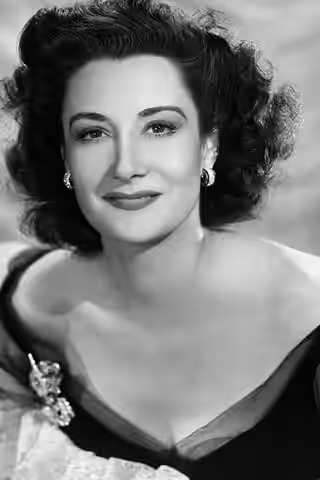
Gloria Holden played cool, patrician women who watched more than they spoke, and she is remembered for one of them, the reluctant vampire of Dracula's Daughter. Later pictures gave her wives and bystanders; in the best, one scene was enough.
Fi1m perspective
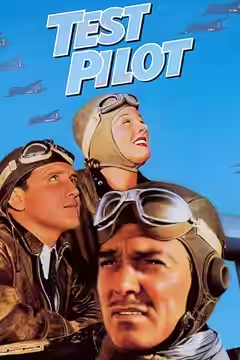
In Test Pilot (1938) Gloria Holden has one scene. She is Mrs May Benson, another flyer's wife at the air race, and while Myrna Loy's Ann is given speech after speech about the fear of being married to the sky, Holden is given none. She stands there and shows Ann what she has signed up for, and the scene tells us more than the script's three or four versions of the same thought. It is the best domestic moment in a film that is otherwise happiest in the air, and it belongs to a player whose name comes well down the bill.
That was the shape of her career, more or less. Born in London and taken to America as a child, she came up through stock theatre and had her first credited film part in Wife vs. Secretary (1936). The same year she was the Countess Marya Zaleska in Dracula's Daughter, and that is the performance she is remembered for: a vampire who does not want to be one, played with a cool, aristocratic reserve that critics still describe as hypnotic. It was her only starring role. Hollywood decided she was the woman who looked down on people, cast her as society wives and femmes fatales, and after 1937 the parts were mostly supporting ones in features and B-pictures, until she stopped with This Happy Feeling in 1958.
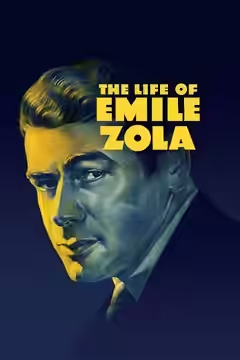
The prestige pictures used her carefully and not generously. In William Dieterle's The Life of Emile Zola (1937) she is Alexandrine, wife to Paul Muni's Zola, and her job is to watch him from the doorway while he turns from a thin clerk into a stout man of letters. Muni gives a technician's performance, every gesture chosen; Holden gives the film someone who lives with the technician, and the script gives her very little back. We noticed her anyway, and we noticed the waste.
We were moved by that air-race scene in Test Pilot more than a scene that size has any right to manage, and we can say why. Victor Fleming's film is built on real aeroplanes doing dangerous things, and Ray June's cameras spend their best minutes in the sky. On the ground Loy carries the argument, Spencer Tracy says almost nothing and quietly takes the film off everyone, and Holden, for a minute or two, does what Tracy does: she lets us read her rather than telling us what to read. Stillness was her instrument. In a decade of actors who talked, she was cast for the way she held her face, and directors mostly spent that on women we were meant to dislike.
She did not much care for the one part that kept her name alive. Asked about Dracula's Daughter near the end of her life, she is reported to have said only, "Oh, that awful thing." Start there regardless, because it is the one film that keeps her in frame long enough to show what she could do. Then find the air race in Test Pilot and watch what she does with no speech at all.
Biography
Gloria Anna Holden (5 September 1903 – 22 March 1991) was an English-born American actress. She trained at the American Academy of Dramatic Arts and began her career in stock theatre before appearing in films from the mid-1930s.
She is best known for her title role as Countess Marya Zaleska in Dracula's Daughter (1936) and for playing Alexandrine Zola opposite Paul Muni in The Life of Emile Zola (1937). Other credits include Wife vs. Secretary (1936), Test Pilot (1938) and Dodge City (1939). Her screen career continued into the late 1950s, with appearances in films such as Auntie Mame (1958).