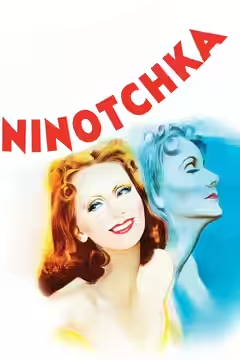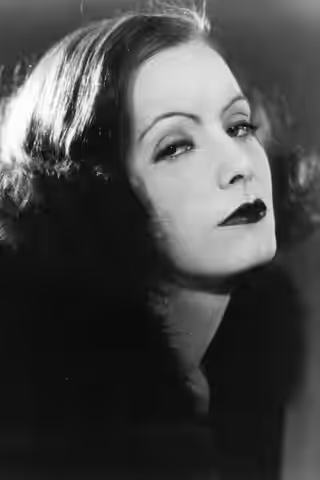
Garbo's trade was doing less than anyone else in the frame and letting the camera come to her. It made her the saddest face in Hollywood for a decade, and Ninotchka is the proof that the stillness was a choice.
Fi1m perspective
Watch her wait. In the first forty minutes of Ninotchka (1939) Garbo asks a Paris porter why he wants to carry her bags, tells a count to stop flirting, and looks at a hat in a shop window as though it were evidence, and her face barely moves through any of it. That is the whole method. The head goes down a little, the lips flutter, and the camera, usually William H. Daniels's, comes in close and does the rest. Other actors of the period worked to be looked at. Garbo let it happen.
The career has one shape. She came out of Sweden in Mauritz Stiller's The Saga of Gösta Berling (1924), and Stiller got her the MGM contract that brought her to Hollywood in 1925. The silents made her a star, Flesh and the Devil (1926) chief among them, and Anna Christie (1930) proved the voice worked; the studio sold that on two words and an exclamation mark, and would use the trick again. Then came the decade of dying beautifully: Grand Hotel (1932), where she asked to be alone and was never afterwards allowed to be, Queen Christina (1933), Anna Karenina (1935), Camille (1936). After Ninotchka there was Two-Faced Woman (1941), and then nothing. She stopped, and she did not come back.
The doubt about her has always been the same one: whether doing so little is acting at all, or whether the face was doing the work and the actor was simply standing behind it. It is a fair question, and Ninotchka is the best answer we have. Lubitsch's joke only works if the stillness is deliberate, because the film spends forty minutes daring her to break it. When Melvyn Douglas falls off his chair in the café and she finally laughs, we laughed too, and then found ourselves more moved than a pratfall should manage, because she had held that face so long that letting go of it felt like a confession. She chose the moment. A face cannot choose.
She needed the right people around her and, in 1939 at least, had them. Daniels lit her hard and flat when Ninotchka arrives and softer as Paris gets to her, and Adrian put her in a suit that looked issued rather than bought. Clarence Sinclair Bull photographed her hundreds of times off the set, and the stills are a fair guide to the films: the face at rest, waiting. The limit of the method is that it needs a director willing to hold on her and a script willing to wait. Lubitsch understood that, and the last half hour of his film, when the script stops waiting and starts hurrying, is the weakest stretch she is in.
Start with Ninotchka, which is the one we can vouch for and the one that shows the trick with the lights on. Then go back to the dying, knowing that none of the stillness was an accident.
Biography
Greta Garbo was a Swedish-American actress. Born Greta Lovisa Gustafsson in Stockholm, Sweden, she trained at the Royal Dramatic Theatre in Stockholm and made her film debut in a small role in Luffar-Petter (1922). She gained prominence in The Saga of Gösta Berling (1924) before signing with Metro-Goldwyn-Mayer.
Garbo starred in numerous films during the silent and early sound eras, including Flesh and the Devil (1926), Anna Christie (1930), Grand Hotel (1932), Queen Christina (1934), Anna Karenina (1935), Camille (1936) and Ninotchka (1939). She received Academy Award nominations for Best Actress for Anna Christie, Romance (1930) and Camille, and was awarded an honorary Oscar in 1955. Her final film was Two-Faced Woman (1941). She became a US citizen in 1951 and died in New York City in 1990.