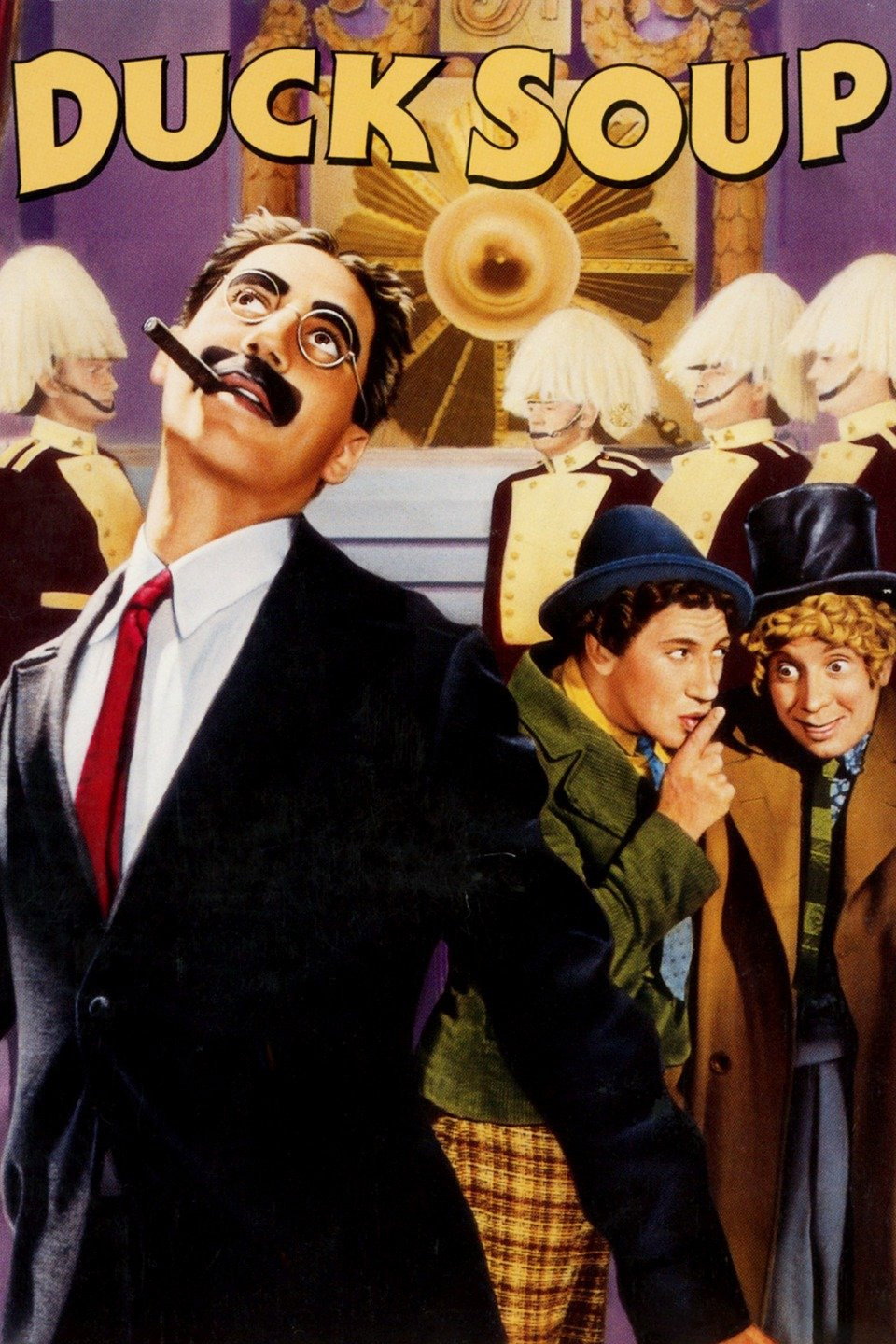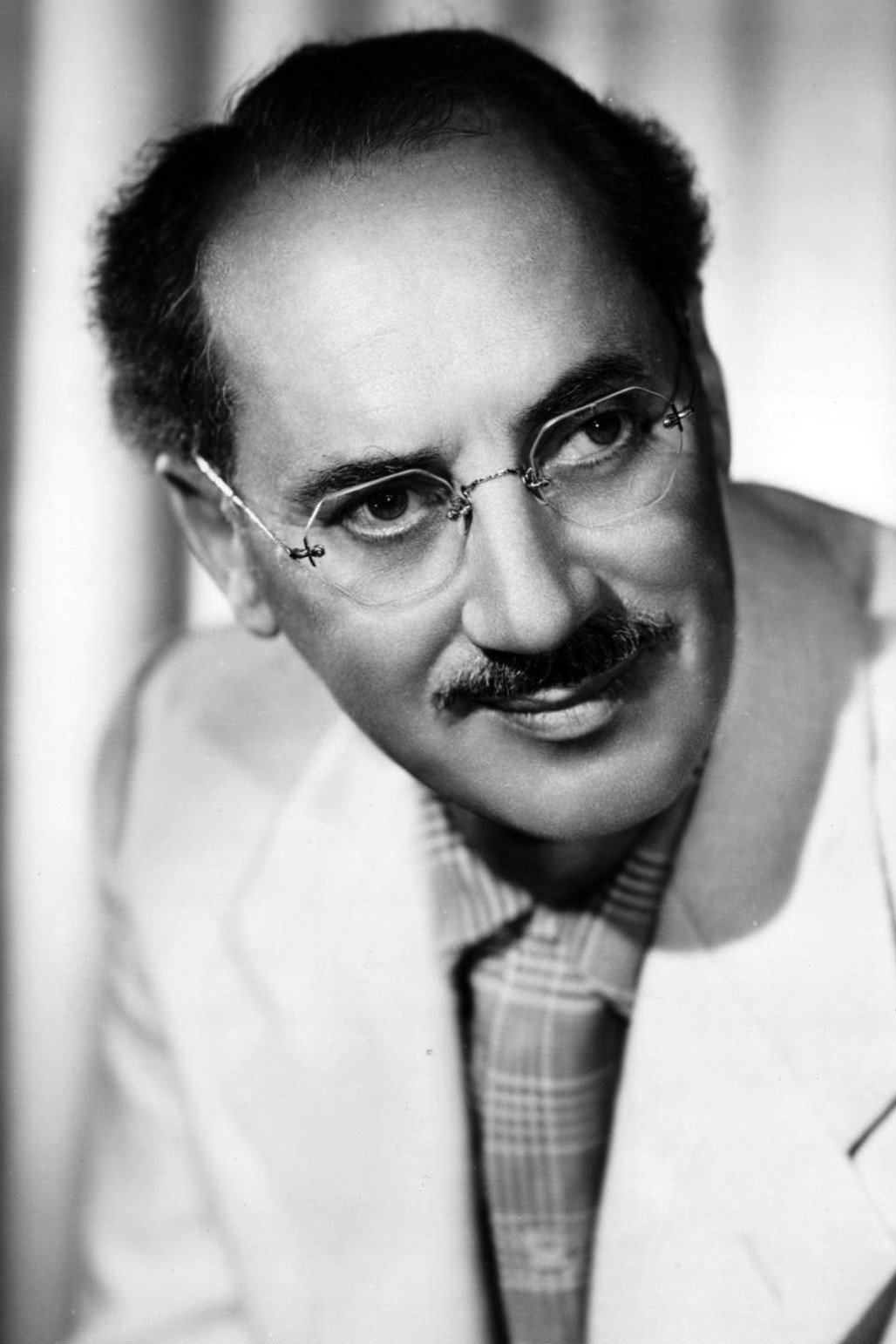
Groucho Marx makes authority look foolish by taking charge himself, then refusing to behave. We recommend Duck Soup for the precision of his insults and the brisk direction that stops his rudeness becoming a chore.
Fi1m perspective
The painted moustache, glasses and stoop announce Groucho Marx before he speaks. In Duck Soup (1933), his Rufus T. Firefly makes no effort to justify being put in charge of a country. He treats the people around him as sources of material and abandons a subject as soon as he finds a better joke. We laughed at the calm way he supplies insults, because he makes the recipient’s expectation of courtesy seem unreasonable. The delivery is exact, however irresponsible the man.
That verbal speed came through a career in vaudeville and the brothers’ Broadway shows before their films began in 1929. Animal Crackers (1930), adapted from their stage show, gives him Captain Jeffrey T. Spaulding, the explorer whose title fits his taste for dubious authority. A Night at the Opera (1935) belongs to the move from Paramount to MGM, where more structured comedy and romantic subplots gave the brothers less freedom to disrupt proceedings. The plots became tidier; we do not think tidiness was what they needed.
Duck Soup gives the strongest reason to stay with Groucho’s bad manners. Director Leo McCarey lets a conversation establish itself just long enough for him to overturn it, while editor LeRoy Stone keeps the interruptions distinct. Henry Sharp’s cinematography leaves the performers’ movements clear, allowing Chico Marx and Harpo Marx to work at a different pace from Groucho’s speech. We can follow the physical business without needing it to hurry. His speed works better with that contrast than it would as an uninterrupted succession of insults.
The limit is how long everyone else must endure the joke. In Duck Soup, some of Chico and Harpo’s physical harassment continues after the surprise has gone, and the thin story cannot help a routine that misses. Groucho’s conversational evasions generally move on sooner, which makes him easier company than his behaviour ought to allow. We would not mistake his precision for kindness, but the film usually finds another laugh before the rudeness wears us down.
With You Bet Your Life (1947–1961), his later solo career put the emphasis on ad-libbed interviews in a radio and television quiz show. The format suited a performer who could make an encounter interesting simply by refusing to conduct it properly. Start with Duck Soup, where McCarey gives him enough room to misbehave and knows when to move on.
Biography
Groucho Marx, born Julius Henry Marx, was an American comedian and actor. He was the third of five brothers who performed together as the Marx Brothers in vaudeville, on Broadway and in films.
He is best known for his roles in the Marx Brothers films The Cocoanuts (1929), Animal Crackers (1930), Monkey Business (1931), Horse Feathers (1932), Duck Soup (1933), A Night at the Opera (1935), A Day at the Races (1937) and At the Circus (1939). Marx later hosted the radio and television game show You Bet Your Life.
He died in Los Angeles on 19 August 1977.