Guillaume Brac makes small summer films about young people who have wandered into the wrong company and are better for it. They are funny, kind and observant, and we like them; we also wish, now and then, that he would push a little harder.
Fi1m perspective
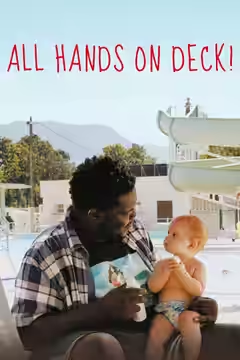
A Guillaume Brac film tends to start with somebody going where they were not invited. In All Hands on Deck (2021) it is Félix, who has spent one night with a girl called Alma after a dance by the Seine and follows her on her family holiday to the south, with his friend Chérif in the passenger seat because Félix asked. Most of what follows happens in a car and a tent. Brac has said, "I need political and social issues to be smuggled in, behind a screen of lightheartedness and comedy", and that is a fair account of how he works. The jokes are on the surface, the class and the colour of the people in the car are underneath, and he trusts you to notice without being told.
He came to features sideways. A World Without Women (2012) was a medium-length film about awkward romantic entanglements in a small seaside town, and it set the pattern: holiday light, misplaced desire, a melancholy that arrives without announcing itself. Tonnerre (2013), his first full-length feature, gave Vincent Macaigne a story of thwarted desire in a small town, and Macaigne has worked with him twice. July Tales (2017) was developed with students from the Paris conservatory, and Treasure Island (2018) is a documentary about a leisure park near Paris. The fiction and the documentary are not far apart. Brac builds characters out of conversations with young and often inexperienced actors, then sets them down somewhere a real summer is going on around them.
What he does well is the group. In All Hands on Deck Éric Nantchouang, Salif Cissé and Asma Messaoudene never play to the camera, and the film catches the small shifts of mood between three people who do not quite know each other. The scene that got at us is early and is not a joke: Félix finds Alma, and her face tells him what he has done. Brac neither punishes him nor lets him off. We felt for him more than we thought the film had earned, and then realised it had been earning it since the dance. Catherine Paillé, who wrote it with him, deserves some of the credit for a script that lets the moment sit.
The limits are the same as the virtues. Everyone mentions Éric Rohmer, and the comparison holds up to a point. Rohmer's people were cruel to each other in complete sentences; Brac's are kind and a little vague, and the film is warmer and thinner for it. The social and racial tensions he smuggles in stay smuggled: noted, glanced at, then set aside for a swim. In All Hands on Deck the last half hour drifts where it should be heading somewhere, and most critics were more forgiving of that than we were.
If you want an evening of sunlight and decent people, he is a safe pair of hands, and there are not many of those. We would like, once, to see him let the weather turn.
Biography
Guillaume Brac is a French film director, writer and producer. He studied at HEC Paris before graduating from La Fémis in the production section in 2005.
His feature films include Tonnerre (2013), which premiered at the Locarno Film Festival, and All Hands on Deck! (2020, also known as À l'abordage), which he also wrote and which screened in the Panorama section at the Berlin International Film Festival. Earlier works include the medium-length film Un monde sans femmes (2011, also released as A World Without Women).
Brac has directed several other features and shorts, including July Tales (2017) and the documentary Treasure Island (2018).