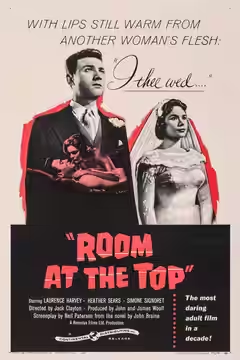
A quiet, watchful ingénue of the late 1950s whose reputation rests on saying little and meaning more. In the one film we have reviewed the script gave her nothing to mean, and we take the rest of the case on trust.
Fi1m perspective
Susan Brown sits in the amateur dramatic society in Room at the Top (1958) with a boyfriend who flew in the war and a father who owns the factory, and Joe Lampton looks at her the way he looks at the big house on the hill. Heather Sears plays her fair, pleasant and rich, and that is the whole of what Paterson's script asks of her. Sears was said to be good at girls like this: the innocent whose plainness hides a little irony, a little more thought than anyone credits. We kept waiting for a flicker of the girl who knows what she is worth to Joe and lets him see that she knows. It never arrived, and we do not think that is entirely her fault. Susan is written as a girl whose only quality is being rich, and the film has Simone Signoret's Alice to be the woman with a self. Sears is left to be the prize.
The screen career was short. She trained at the Central School of Speech and Drama and went into repertory at Windsor in 1955; Jack Clayton arranged a seven-year contract with Romulus Films that kept six months of every year free for the stage and television, which tells you where she thought the real work was. The title part in The Story of Esther Costello (1957) came almost at once: a deaf-mute girl, a part played without speech, and the role that made her name. She said preparing it was "like learning something completely out of one's normal range", and it is the film her admirers point to when they say she could hold a screen without a line. Then Room at the Top, then Miriam Leivers in Sons and Lovers (1960), the thoughtful companion of the Lawrence adaptation, then Christine in Hammer's The Phantom of the Opera (1962). The Black Torment (1964) was close to the last of it.
From the mid-1960s she cut her screen work back to raise three sons and went where the parts were, which was the theatre: Antigone, Hedda Gabler, Brecht and Ayckbourn at the Haymarket in Leicester through the 1970s, a television Biddy in Great Expectations (1974), a last screen role in 1989. Those who write about her describe the same things across the years, a naturalism that reads as honesty and an understatement that draws the eye rather than losing it. We know most of this by report, and we say so.
What we can vouch for is the film we have reviewed, and there she is a well-made, underused piece of it. See Room at the Top for Signoret, and watch what Sears does in the drawing-room scenes when she has nothing to do: she listens well, which is rarer than it sounds. If you want the case for her made properly, The Story of Esther Costello is where the people who make it begin.
Biography
Heather Sears (1935–1994) was a British stage and screen actress. She trained at the Royal Central School of Speech and Drama in London and began her career in repertory theatre in the mid-1950s.
Her breakthrough came with the title role in The Story of Esther Costello (1957), for which she received a Golden Globe nomination and a BAFTA award for Best British Actress. She appeared as Susan Brown in Room at the Top (1958) and as Miriam Leivers in Sons and Lovers (1960), and later played Christine Charles in The Phantom of the Opera (1962). She also worked extensively in television, including an episode of Tales of the Unexpected (1979).
Sears was married to art director Anthony Masters from 1957 until his death in 1990; they had three sons.