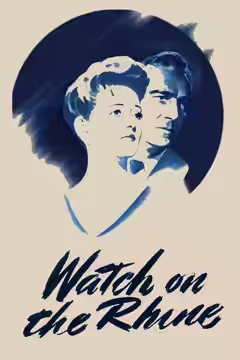
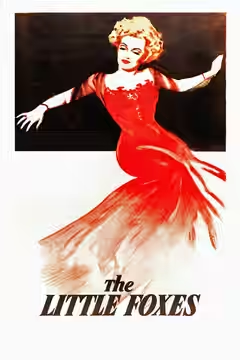
Herman Shumlin was a man of the theatre who directed two films, and the one we have seen is a play that has been filmed and knows it. He gave actors room and left the camera where it stood.
Fi1m perspective
In Watch on the Rhine (1943) the Müller family crosses into the United States by train, the front door of the Farrelly house closes behind them, and for most of 114 minutes it does not open again. Shumlin had directed Lillian Hellman's play on Broadway and had never made a film. Having found a good angle on a sofa, he tends to stay there. What you get instead is the thing he was good at: people given the time to say long speeches properly, and a cast chosen with care.
That was his trade. He began producing on Broadway in 1927 with Celebrity and over 47 years handled 45 productions as producer, director or both, most of them serious contemporary plays with something to say about the world outside the theatre, often by writers nobody had heard of yet. The writer who mattered most was Hellman. He produced and directed four of her plays, from her first hit, The Children's Hour (1934), through The Little Foxes (1939), which ran 410 performances, to Watch on the Rhine (1941) on stage the year before he filmed it. He revived The Corn Is Green (1940) more than once, latterly with Ethel Barrymore, and staged Inherit the Wind (1955) for 806 performances. He directed two films in the 1940s, Watch on the Rhine and Confidential Agent, and then went back to the theatre, later teaching directing at City College of New York and producing for the last time in 1974.
The film tells you what he could and could not do. Paul Lukas is remarkable as an exhausted anti-fascist, and it is Lukas's tiredness that held us: a man who has been brave for so long he can barely lift his head to do it again. Bette Davis, top-billed, has the smaller part and plays it with an intensity that sometimes reads as a star waiting for a scene that never comes. The children speak like small delegates to a conference, and we caught ourselves waiting for the youngest to leave. Those flaws belong to Hellman's play. Shumlin's direction does not remove them, and his camera never finds anything the stage could not. By his own account of the shoot, as the record has it, his inexperience led to clashes with performers and left the technical side to his cinematographer, and it shows in the stillness.
We hold him as a producer on the film of The Little Foxes (1941), which William Wyler directed and Gregg Toland photographed so that nobody can leave the frame. It is the better film by some distance, and his name is not what we remember from it. The comparison is unkind but useful: the same play, the same star, and a director who understood that a room on film is not a room on stage.
Asked about a bad notice, he said: "George Jean Nathan wasn't worth producing, either." We would not have enjoyed giving him notes. We have given him one anyway. See Watch on the Rhine for Lukas, and see it at home, where a filmed play feels less like a compromise.
Biography
Herman Shumlin (1898–1979) was an American theatrical producer and director whose Broadway career spanned nearly five decades. He produced and directed numerous serious dramas, beginning with credits in the late 1920s and continuing into the 1970s.
Shumlin produced and directed the original Broadway production of Lillian Hellman’s The Little Foxes (1939). Other notable stage productions include Watch on the Rhine (1941), The Corn Is Green (1940 and revivals) and Inherit the Wind (1955). He directed the film adaptations of Watch on the Rhine (1943) and Confidential Agent (1945), and served as producer on the 1941 film of The Little Foxes.
Born in Atwood, Colorado, Shumlin later taught directing at the City College of New York.