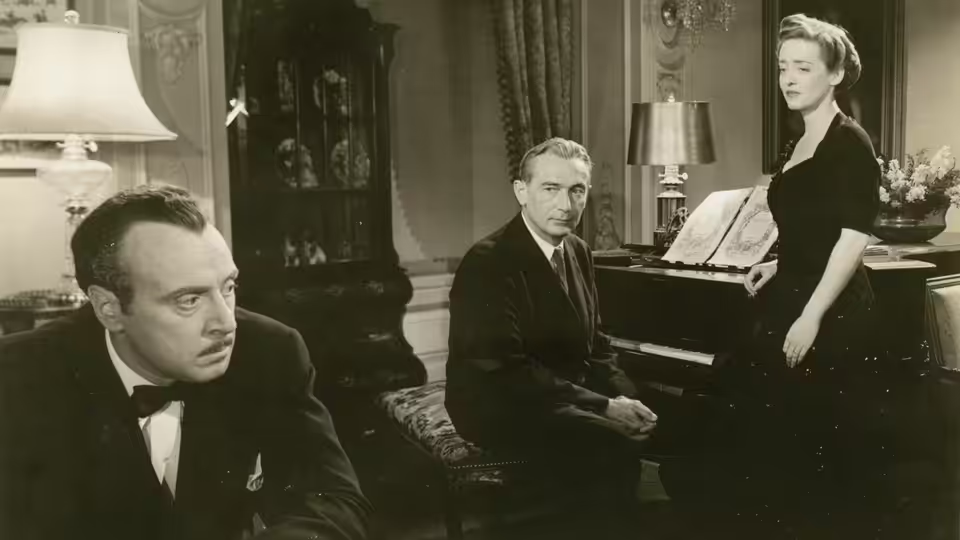
Herman Shumlin’s film of Lillian Hellman’s play brings the war into a Washington drawing room and mostly keeps it there. Paul Lukas is remarkable as an exhausted anti-fascist; Bette Davis, top-billed, is given rather less to do. Stagey, talky, and still worth an evening.
Watch on the Rhine is a play that has been filmed rather than a film, and it is honest about it. Herman Shumlin, who directed Lillian Hellman’s play on Broadway and had not made a film before, keeps the camera in the rooms where the talk is. Dashiell Hammett’s screenplay opens things out a little, with the Müller family crossing into the United States by train, and then closes the front door of the Farrelly house behind them and, for most of 114 minutes, does not open it again. Whether that bothers you decides whether the film is for you. We think it is a good film that would rather be a good play, and we recommend it on those terms.
The idea is a sharp one. Sara Müller (Bette Davis) comes home to her mother’s house outside Washington in the spring of 1940, with her German husband Kurt (Paul Lukas) and three children who have grown up in whatever country was safe that year. Kurt says he is an engineer. He is not. The Farrellys are rich, kind, argumentative and have never had to think about any of it, and staying in their house is a Romanian count, Teck de Brancovis (George Coulouris), who has run out of money and spends his evenings losing what is left at cards in the German embassy. The war, in other words, is already in the house. Nobody has noticed.
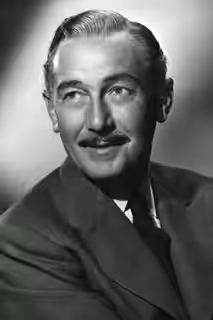
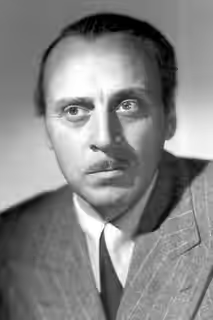
Lukas is the reason to watch. He plays Kurt as a man who has been tired for years and has decided that tiredness is not an excuse. His voice hardly rises. He counts money slowly, with fingers that do not quite work, and he answers his children’s questions about what he does with the patience of someone who has rehearsed the answer many times. We were moved, more than we expected to be by a film this well behaved, by a scene in which he simply tells Fanny why he does what he does, at a table, without a speech-maker’s pauses. It is the plainest acting in the film and it makes the rest of the cast look busy.
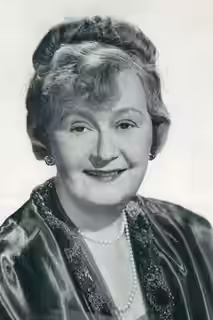
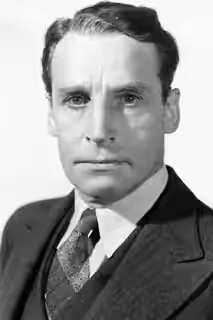
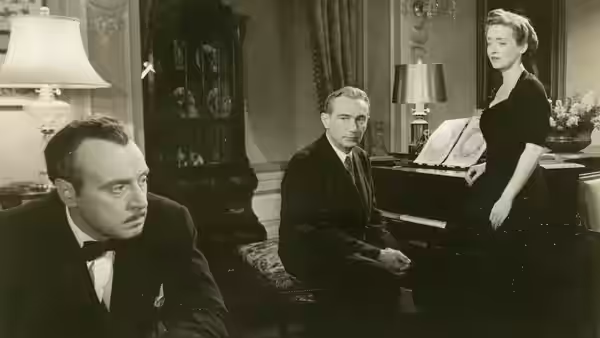
Lucile Watson’s Fanny is the other performance we would keep. She comes in as a comic grande dame, fussing about breakfast and her late husband’s opinions, and she is allowed to go on being funny while the ground shifts under her. Coulouris makes Teck civil, soft-voiced and frightening, a man who watches luggage. His card games with Henry Daniell’s Von Ramme are the film’s best staged scenes: a long table, a few Germans in evening dress, and Teck losing with a smile.
Merritt B. Gerstad and Hal Mohr light the Farrelly house brightly and evenly, so that nothing hides; this is a film about what happens in full view. Orry-Kelly dresses Davis in worn, plain clothes and Geraldine Fitzgerald’s Marthe in the opposite, which tells you their situations before anyone says a line. Rudi Fehr cuts slowly and lets scenes run, which is right for the material. Max Steiner’s score is, by his standards, restrained, though he cannot resist underlining the entrances, and once or twice the strings tell us what to feel a beat before Lukas has finished doing it.
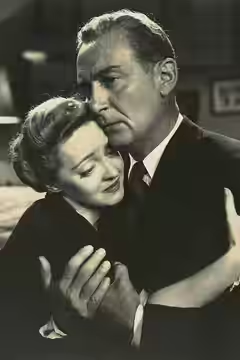
The flaws are the play’s, mostly. The children speak like small delegates to a conference, and the youngest, Bodo (Eric Roberts), is written to be adorable and lectures the adults on economics; we found ourselves waiting for him to leave. Davis, top-billed, has the smaller part and knows it. She plays Sara with a held-back intensity that reads in some scenes as devotion and in others as a star waiting for a scene that does not come. Shumlin’s camera, having found a good angle on a sofa, tends to stay there.
What the film says is simple and still true: the danger is not in Berlin but at the breakfast table, among nice people who would rather not know. Hellman and Hammett put the argument in a drawing room and let the furniture make it. The second half takes a turn we will not describe, and it is handled quietly.
Watch it as you would a good revival on a wet Sunday afternoon, prepared for the talk to be the action. Give Lukas your attention and forgive the child.