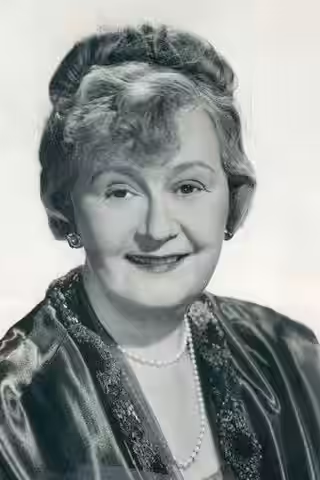
Lucile Watson played grand old women who talk too much at breakfast, and made them funny without making them fools. Fanny Farrelly in Watch on the Rhine is the part to see, and the one where the joke is allowed to stop being a joke.
Fi1m perspective
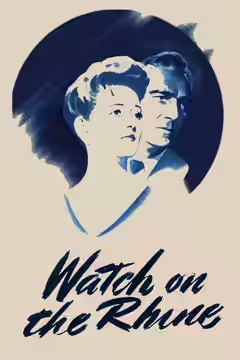
Fanny Farrelly comes into Watch on the Rhine (1943) fussing about breakfast and about what her late husband would have thought, and for a while she is there to be laughed at. Then the film keeps her talking while the war walks into her Washington drawing room, and she goes on being funny after it has stopped being safe to be. That is what Lucile Watson did. She played formidable dowagers and crotchety matriarchs, with a crisp, peppery way of speaking and manners grand enough to suggest the furniture had been in the family for some time.
She was a stage actor first and for longest. She began on Broadway in 1902 after training in New York, and appeared in something like fifty plays over the following half century, most of them high comedy, most of them with her as the matriarch. Films came late and in a supporting capacity: a first appearance in 1916, then a proper run from the 1930s through the 1940s, before she retired around 1954. Fanny was her most acclaimed part on stage, in Lillian Hellman's play in 1941, and Herman Shumlin's film had the sense to bring her along with it.
It is the performance we would keep, alongside Paul Lukas's exhausted anti-fascist. Bette Davis is top-billed and given rather less to do; Watson, well down the bill, gets the scenes and holds them. We laughed at her for the first half hour, and somewhere in the second half realised we had stopped laughing and could not say when. She does not change gear where you can see it, which is the whole of the trick and the reason it works on a stagey, talky film that could have been a filmed play and mostly is one.
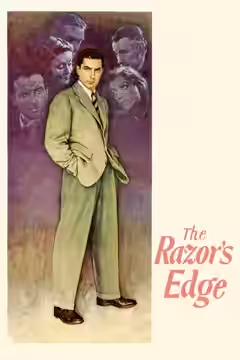
Her other pictures give the same woman different hats. She is Mrs Morehead, Norma Shearer's wise mother, in The Women (1939); Lady Margaret Cronin in Waterloo Bridge (1940); a grandmother in Song of the South (1946); and Louisa Bradley, Gene Tierney's mother, in The Razor's Edge (1946), a handsome, well-acted film we found more interested in its society than its saint, and in which our attention went to Tierney and Clifton Webb. Nobody seems to have had a bad word for her, and the nearest thing to a reservation is that she was cast as the dowager so reliably that the parts began to look interchangeable. She had no illusions about it. "To become a comedienne is the most difficult of all, I think, but it is also difficult to continue to be one after you have learned the technique."
Start with Watch on the Rhine, and watch her while the men are talking. The film thinks the argument is happening at the card table; a good deal of it is happening in her face.
Biography
Lucile Watson (also credited as Lucille Watson) was a Canadian actress who worked primarily on the stage in the United States, with a number of film roles. Born in Quebec City, she trained at the American Academy of Dramatic Arts in New York and made her Broadway debut in 1902. She appeared in dozens of Broadway productions over several decades.
Her film work included supporting roles as matriarchal characters in The Women (1939), Waterloo Bridge (1940), Watch on the Rhine (1943), The Razor's Edge (1946) and Little Women (1949). For her performance as Fanny Farrelly in Watch on the Rhine, she received an Academy Award nomination for Best Supporting Actress. She retired from acting in the mid-1950s.