Jack Clayton made seven features in nearly sixty years in the trade, most from novels, most about someone wanting what they should not have. He was a fine director of rooms and faces and a less sure one of events.
Fi1m perspective
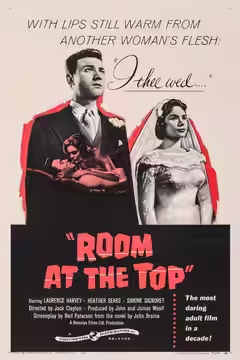
Joe Lampton gets off a train in a northern town with one suitcase, looks up at the houses on the hill where the mill owners live, and asks who owns the biggest. Jack Clayton lets him look. That is the Clayton method in one shot: the wanting is on the face, and what the man does about it comes later and matters less.
He came up the long way, starting as a tea boy at Alexander Korda's Denham Studios in 1935 and working through the cutting room and the assistant director's chair before the RAF Film Unit and a short, The Bespoke Overcoat (1955). Room at the Top (1958) was his first feature, and it is usually credited with starting the British New Wave because of how plainly it talked about class and sex. He followed it with The Innocents (1961), The Pumpkin Eater (1964) and Our Mother's House (1967), then went to America for The Great Gatsby (1974) and Something Wicked This Way Comes (1983), and finished with a television film, Memento Mori (1992). Seven features in all. He was slow, he was choosy, and he was often making the wrong film for the market of the moment.
Nearly all of them come from novels, and the ones people keep coming back to are about a woman, or a child, and what is going on inside them. Clayton's gift was for the interior: the glance, the pause, a house dressed so that you know who owns it. He was at his best with actresses, and Room at the Top is the case in point. Simone Signoret, as the married woman Joe falls for while chasing the boss's daughter, is the reason to watch it, and Laurence Harvey, as Joe, is the reason it is very good rather than fine. Freddie Francis photographed two of his films, and the visual care critics always mention is at least partly his.
Where Clayton was weaker was at events. The last third of Room at the Top turns to melodrama, and we could hear the machinery start; for two thirds of its 115 minutes we had been watching people, and then we were watching a plot happen to them, and the disappointment was sharp because the people had been so good. It does not undo the film. It does explain why the story is sometimes called dated, and we think that is a fair word. His American films are a separate difficulty: Something Wicked This Way Comes was altered in post-production, and neither it nor Gatsby is generally counted a full success.
Start with Room at the Top and watch Signoret. Then The Innocents, which shows he could do dread as well as longing. After that you are into a filmography short enough to finish in a week, and not many directors with sixty years in the trade can say that.
Biography
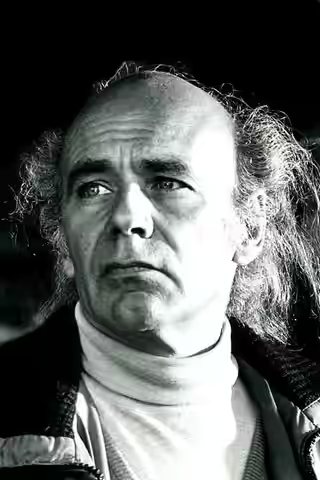
Jack Clayton was a British film director and producer. Born in Brighton on 1 March 1921, he began working in the film industry at the age of fourteen and rose through roles including assistant director and producer. His first directorial credit was the short film The Bespoke Overcoat (1955).
Clayton made his feature debut with Room at the Top (1959), an adaptation of John Braine’s novel that received six Academy Award nominations, including for Best Director. He went on to direct literary adaptations such as The Innocents (1961), The Pumpkin Eater (1964), Our Mother’s House (1967), The Great Gatsby (1974) and Something Wicked This Way Comes (1983). He died in Slough on 26 February 1995.