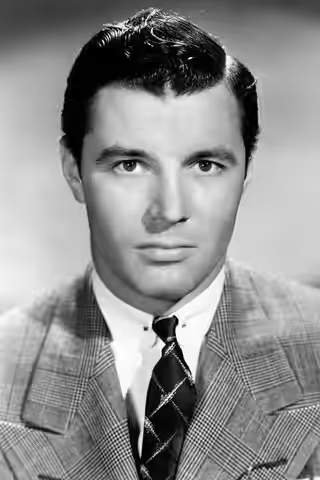
A square-jawed leading man who spent the war years standing where Clark Gable would have stood, James Craig had the jaw and the voice and very little argument in either. In Kitty Foyle he reads his sensible lines as if from a leaflet, and Ginger Rogers decides without him.
Fi1m perspective
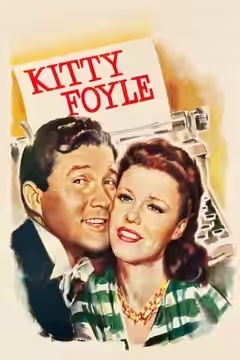
Mark, the doctor without money in Kitty Foyle (1940), has proposed to Ginger Rogers and is waiting for an answer. James Craig plays the wait as a man who has already filled in the forms. He is tall, square in the jaw, pleasant in the voice, and every sensible thing he says arrives in the same even tone, as if he were reading it from the leaflet in the waiting room. Rogers acts opposite him and around him and, in the mirror scene, opposite herself, and she gets more out of her own reflection than she does out of him.
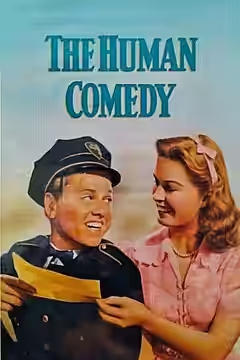
That was his breakthrough, and it tells you most of what you need to know. Craig had been in uncredited and supporting parts at Paramount and Columbia since 1937, then at Universal, and the loan-out to RKO for Kitty Foyle got him noticed. The lead in All That Money Can Buy (1941), the fantasy also known as The Devil and Daniel Webster, followed, and there were reviewers even then who found him too handsome and too intense for a farmer who sells his soul. Then MGM signed him, in the early 1940s, for a plain reason: Clark Gable was going into uniform, and Craig had the same jaw and something like the same voice. The Human Comedy (1943), with Craig as Tom Spangler, was the largest of the A-pictures that came out of the arrangement.
The arrangement ended when Gable came home. After the war Craig went back to supporting work and B-westerns, where the Texas drawl noted in his early training was an asset and nobody asked him to carry the picture. He turned up in Fritz Lang's While the City Sleeps (1956) as 'Honest' Harry Kritzer, worked in television from the mid-1950s, and had one of his last feature parts in The Devil's Brigade (1968). He retired from acting in 1972 and went into estate agency.
We have only reviewed Kitty Foyle, and it is fair to say Trumbo's script gives Mark nothing to be but a set of good opinions with a stethoscope. But we watched Craig's proposal waiting to feel something for the man making it, and we never did; the choice at the pier is meant to be a choice, and he is a large part of the reason it is not. Sam Wood shoots him plainly and lets him alone, which is generous to Rogers and no help to Craig. He plays Mark as if being sound were the same as being interesting.
He stood where a bigger star would have stood, looked right, said his lines clearly and did not get in the way, and for a few wartime years that was a job the studio needed done. Watch Kitty Foyle for Rogers, and notice how completely she makes up her mind without him.
Biography
James Craig (born James Henry Meador) was an American actor. He studied at the Rice Institute, initially planning a career in medicine, before turning to acting after a visit to Hollywood. He began appearing in films in 1937, initially in low-budget westerns and serials.
Craig's breakthrough came with the role of Mark in Kitty Foyle (1940). He signed with Metro-Goldwyn-Mayer and appeared in films including All That Money Can Buy (1941), The Human Comedy (1943) and Kismet (1944). He later took supporting roles in Side Street (1950), While the City Sleeps (1956) and The Devil's Brigade (1968), and worked in television series such as Have Gun, Will Travel (1957). After retiring from acting in 1972 he worked in real estate.