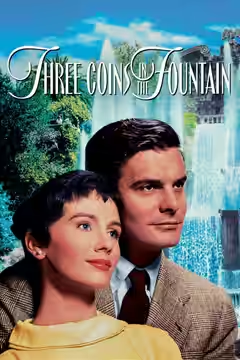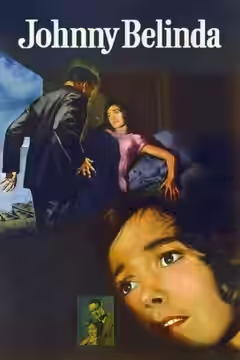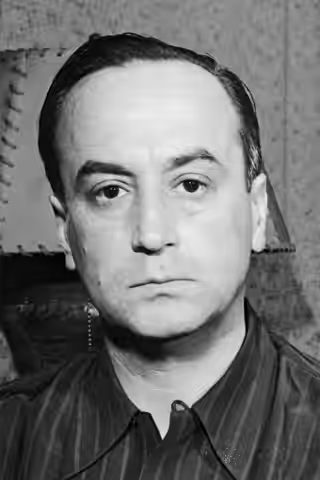
A painter turned studio director, Negulesco was at his best holding the camera on a face and letting it work, as he did for Jane Wyman in Johnny Belinda. The wide, glossy films he made later at Fox are handsome and ask little of us.
Fi1m perspective
Watch the moment in Johnny Belinda (1948) when Belinda understands that the shapes the doctor's fingers make are words. Jane Wyman has no lines in the film, and Jean Negulesco does not help her with any. He holds on her face and lets us watch the idea arrive. It moved us more than we were prepared for, and most of the credit is Wyman's, but some of it belongs to a director who knew when to do nothing. The censorship of 1948 meant the assault at the centre of the story could not be shown and could barely be named, so what he had instead was a long look at a face, and he trusted it.
He came to that trust from painting. Negulesco studied art in Paris after leaving Romania as a teenager, moved to America in 1927, and spent the 1930s and 1940s at Warner Bros on second units and shorts. His first credited feature, The Mask of Dimitrios (1944), was a noir, and the early films are noirs, lit in the deep shadow a painter would recognise. Johnny Belinda was the breakthrough, and it is the film of his we would send a stranger to, with the caveat that Max Steiner's score begs on Belinda's behalf whenever Negulesco declines to.
Then he went to 20th Century-Fox in 1948 and became one of the first directors to work in CinemaScope. How to Marry a Millionaire (1953), Titanic (1953) and, shot on location in Rome, Three Coins in the Fountain (1954) are wide, unhurried and full of things to look at; he liked a long take and a broad composition and had little use for fast cutting. He could make the new frame work for two people in a room as well as for a fountain. Critics have called these films glossy and shallow, and we do not much quarrel with that. They were built to be handsome, and they are.
The word that follows him is journeyman, and it is fair, though it is not the insult it is sometimes meant as. He did not have a style you could pick out across a room; he had judgement about where to put the camera and how long to leave it there, and with a subject worth handling carefully, as Johnny Belinda was, that judgement looks a great deal like art. With a lesser script it looks like good manners.
His output slowed in the 1960s, and he went to live in Spain and took up his brushes again. In his autobiography he wrote: "I lived three golden periods of my time: Paris in 1920, the Riviera in 1927 and Hollywood from 1930 to 1970." Hollywood comes third. Start with Johnny Belinda, and keep a hand near the volume for the Steiner.
Biography
Jean Negulesco was a Romanian-born American film director and screenwriter. Born in Craiova, Romania, on 26 February 1900, he trained as a painter before moving to the United States in the 1920s. He entered the film industry in 1934, initially working as a sketch artist and second-unit director.
Negulesco directed his first feature, Singapore Woman, in 1941. He gained recognition at Warner Bros. for short subjects and feature films including The Mask of Dimitrios (1944), Humoresque (1947) and Johnny Belinda (1948), for which he received an Academy Award nomination for Best Director. Later credits include How to Marry a Millionaire (1953), Titanic (1953), Three Coins in the Fountain (1954) and Daddy Long Legs (1955). He lived in Marbella, Spain, from the late 1960s and died there on 18 July 1993.