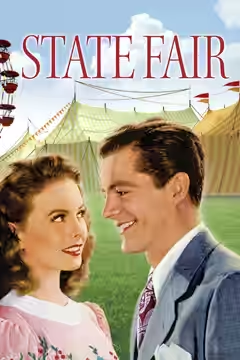
Fox's girl at the window through the late 1940s: pretty, natural, easy to be fond of, and seldom asked for more. Her best moments are the still ones, and the studio rarely trusted her to sing them herself.
Fi1m perspective
Ten minutes into State Fair (1945) a farm girl stands at a farmhouse window in a dress she has nowhere to wear and sings that she is miserable and does not know why. We had settled in for a pleasant afternoon and had a lump in the throat before the song was over. Hammerstein's lyric and Rodgers's drifting tune did most of it, but the face did the rest: Jeanne Crain looking out at nothing, wanting something she cannot name. Her singing voice was usually somebody else's, most often Louanne Hogan's. What Crain herself brought to a scene was the look, and for a few years the look was enough.
Twentieth Century Fox found her after beauty contests and a screen test for Orson Welles, gave her an uncredited bit in The Gang's All Here (1943), and by Home in Indiana (1944) and State Fair had decided what she was for: the wholesome girl next door, then the young wife, in Technicolor romances and musicals. The parts got bigger without changing much. She was Ruth Berent opposite Gene Tierney in Leave Her to Heaven (1945), top of the bill for Joseph L. Mankiewicz in A Letter to Three Wives (1949), and Ann Gilbreth in the family comedy Cheaper by the Dozen (1950). Otto Preminger directed her three times, Mankiewicz twice, and Dana Andrews played opposite her twice, level and watchful and a little tired, as he played everyone. Pinky (1949), for Elia Kazan, is the one occasion the studio handed her a hard dramatic lead and expected her to carry it, and she was credible in it.
What worked is plain enough. She was natural and unforced, and in a nostalgic picture that asks its heroine mainly to be there and be pleasant she was exactly right. What did not work is what directors and critics kept saying about her: that she was bland, that the feeling did not go far down, that the early work in films like In the Meantime, Darling (1944) was weak. We would not put it much differently. In State Fair, once the song is over, she is pretty and pleasant and not much more, and Hammerstein's screenplay, which gives the young people chat rather than scenes, does nothing to help her. The camera was kind to her stillness; the writing seldom gave her anything to do with it.
She wanted out of it. In the mid-1950s she left Fox, dyed her hair red and took tougher, more glamorous parts in westerns and dramas, Man Without a Star (1955), as Reed Bowman, among them. The films came less often from the 1960s and stopped with Skyjacked (1972). Start with State Fair and start at the window. Fox never quite worked out what to do with that face once the music stopped.
Biography
Jeanne Crain was an American actress. Born in Barstow, California, she made her film debut in an uncredited role in The Gang's All Here (1943) and gained early notice in Home in Indiana (1944). She starred as Margy Frake in the musical State Fair (1945).
Crain appeared in numerous films for 20th Century Fox through the 1940s and 1950s. Her roles included Ruth Berent in Leave Her to Heaven (1945), Deborah Bishop in A Letter to Three Wives (1949), and the title role in Pinky (1949), for which she received an Academy Award nomination for Best Actress. Other credits include Cheaper by the Dozen (1950), People Will Talk (1951), Man Without a Star (1955), and The Joker Is Wild (1957).
She continued working into the 1970s, with her final film role in Skyjacked (1972). Crain was married to Paul Brinkman from 1945 until his death in 2003; they had seven children.