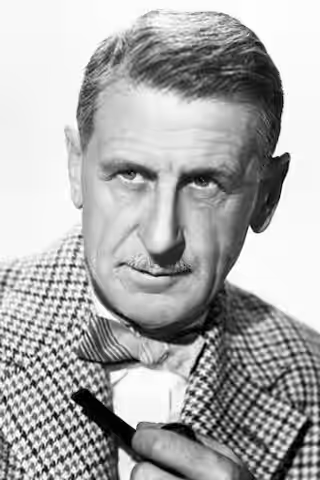
A stage man who came to Hollywood with the talkies and never quite trusted the camera. John Cromwell's films are actor-led, clearly told and, when the actors are not enough, flat. The pictures he is remembered for are remembered for their casts.
Fi1m perspective
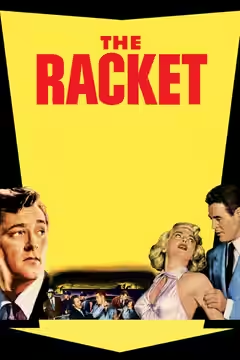
Put John Cromwell's people in a room and he will let them talk. In The Racket (1951) the men of a crime syndicate and the commission chasing them explain the structure of the thing to each other, framed straight on, lit evenly, held for as long as the dialogue lasts. It is the habit of a man who learnt his trade in the theatre, where the audience sits still and the actors do the work. Cromwell said as much himself: "I had to rely enormously on my cameraman, especially at first."
He had been on Broadway since 1912, acting and directing, and arrived in Hollywood in 1928 and 1929, just as the studios needed people who knew how dialogue worked. He began as a dialogue director and actor and was directing features from 1929. What followed was a contract director's career at Paramount, RKO and elsewhere: adaptations of novels and plays mostly, with the odd swashbuckler and prison picture, chosen by the studio rather than by him. Of Human Bondage (1934) made his name and made Bette Davis a star. The Prisoner of Zenda (1937) is the one people still watch for pleasure. Since You Went Away (1944) and Anna and the King of Siam (1946) were the prestige jobs, large casts in period rooms. Caged (1950), a women's prison drama, is harder than most of what he did.
The reputation is for actors, and for actresses in particular. He worked three times with Irene Dunne and three with the producer David O. Selznick. When the cast is strong and the source is a good play or novel, the plainness of his camera reads as tact. When the cast is coasting, there is nothing else in the frame to look at. Nobody has ever picked out a Cromwell shot, and the consensus, which is fair, is that his output goes up and down with the assignment.
The Racket shows the cost. Robert Ryan's old-fashioned gangster is alive from his first scene, Robert Mitchum barely wakes up, and around them Cromwell directs as if reading out the minutes. We were bored in those office scenes, and then annoyed, because a syndicate boss who is only ever a voice on the telephone is a good idea and the film treats it as a stage device rather than a threat. Other hands worked on the picture uncredited, which may explain some of it. It does not explain the choice to hold on a man listening.
He directed his last film in 1961 and went back to the theatre, which had always been where he was surest. If you want to see what he could do, look at what the actors do: Davis in 1934, Ryan in 1951. Cromwell, on his own account, was doing the same.
Biography
John Cromwell was an American film and stage director and actor. Born Elwood Dager Cromwell in Toledo, Ohio, he began his career on Broadway in 1912, appearing in and later directing numerous stage productions before moving to Hollywood in the late 1920s.
He directed more than 40 films between 1929 and 1960, including Of Human Bondage (1934), The Prisoner of Zenda (1937), In Name Only (1939), Since You Went Away (1944), Anna and the King of Siam (1946), Dead Reckoning (1947) and Caged (1950). Cromwell directed The Racket (1951), a remake of the 1928 film based on the play in which he had appeared on stage. His later directing work was limited after he was blacklisted in Hollywood from 1951 to 1958.