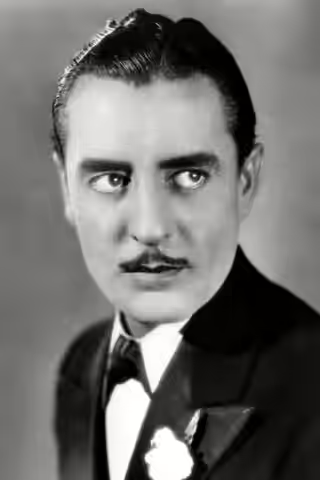
The Great Lover of the silent screen, all slender grace and impassioned face, John Gilbert was at his best when he stopped making love and played an ordinary man, as in The Big Parade. Sound arrived and found him in the wrong style.
Fi1m perspective
Watch John Gilbert make love on a silent screen and you see a man throwing his whole self at a feeling. He was slight rather than muscular, and he carried desire in the face and the hands, in the lean towards a woman and the look held a beat past comfort. Opposite Greta Garbo in Flesh and the Devil (1926) that intensity met its match, and the pairing fixed him in the public mind as the Great Lover. It is the label he is remembered by, and it is not the best of him.
He had been in films since around 1915, an extra at Thomas Ince's studio who also wrote and assisted directors, then a featured player at Fox from 1921 and a star at MGM from 1924. The year that made him was 1925, with The Merry Widow for Erich von Stroheim and The Big Parade for King Vidor, who directed him three times. The late 1920s were the peak, with four films opposite Garbo. Then sound came in. His Glorious Night (1929) is the film usually named as the moment voice and image failed to match, and whatever the truth of the recording, a manner built for an audience that could not hear him sounded old-fashioned once it could. His contract ended in 1933 after supporting parts; The Captain Hates the Sea (1934) was the last film. He died in January 1936.
The film to see is The Big Parade. Gilbert plays Jim Apperson, a young American sent to the First World War, and he plays him plainly, without the flourishes of the romantic pictures. We were moved by it more than we expected to be, because he refuses to be brave for us: Apperson is a boy who does not know what a war is for, and Gilbert lets him find out slowly, in the body, rather than announcing it. He told Screenland in 1927 that "The camera must catch a mood. It must show life. I never want to play the role of a hero." In Vidor's film he got his wish, and it is the performance that lasts.
The romantic roles have aged less kindly. The full-body ardour the silents asked for can look like posing to anyone raised on underplaying, and next to Garbo, who is still where he is all movement, he can seem to be doing too much. That is the pairing working, not failing; she supplies the cool and he supplies the heat, and the films need both. Sound simply made the mismatch harder to ignore. Queen Christina (1933), in which Garbo insisted on casting him as Antonio, is the one talkie worth seeking out.
Start with The Big Parade, then Flesh and the Devil, and leave the talkies until you already like him. Gilbert's misfortune was to be made for a way of acting that lasted about a decade. Most actors never find even one.
Biography
John Gilbert (born John Cecil Pringle; also credited as Jack Gilbert) was an American actor. He was born on 10 July 1897 in Logan, Utah, and died on 9 January 1936 in Los Angeles, California.
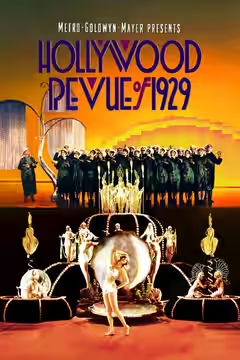
He began in films around 1915 and became a leading man in the silent era after signing with MGM in 1924. His notable roles include James 'Jim' Apperson in The Big Parade (1925), Prince Danilo Petrovich in The Merry Widow (1926), Leo von Harden in Flesh and the Devil (1926), and Antonio in Queen Christina (1934). He appeared as himself and Romeo in The Hollywood Revue of 1929 (1929). His career declined with the advent of sound films.