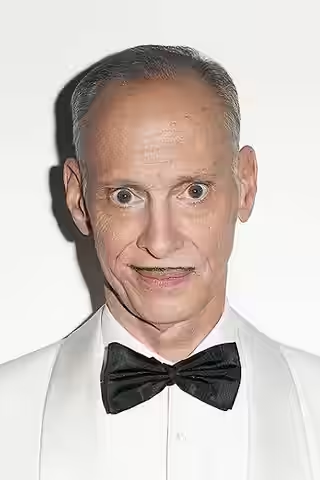
John Waters's comedies give outrageous performers room to work, and we value the commitment he gets from them. Our patience runs shorter when the disgust outlasts the joke, or rough workmanship blunts the comedy.
Fi1m perspective
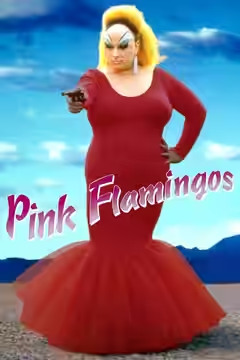
Divine takes charge in Pink Flamingos (1972), and John Waters's appetite for bad behaviour becomes easier to enjoy. We laughed at how completely Divine commits to the excess; the less rewarding stretches leave disgust to do all the work. Waters is its producer, writer and director, and his willingness to let performers push hard gives the comedy much of its appeal. We recommend it cautiously, for the cast rather than the reliability of the jokes.
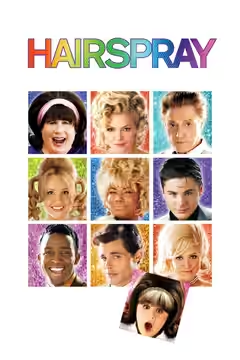
That company matters beyond a single film. Working with Baltimore regulars known as the Dreamlanders, including Divine and Mink Stole, Waters made exaggerated behaviour a recurring feature of his comedies. Female Trouble (1974) continued his work with Divine; Polyester (1981) marked a move towards wider audiences. By Hairspray (1988), the comedy had reached a mainstream audience through a satire of 1960s dance shows. He continued to satirise genres he liked, rather than treating their pleasures as something to be embarrassed by.
The difficulty in Pink Flamingos is that exaggeration becomes the default, leaving too few changes of pace. David Lochary and Mink Stole match the broad acting style, but Waters's dialogue too often responds to an excessive idea by making it more excessive. He also serves as cinematographer and editor, and neither job is consistently well done. The awkward images do not always turn the performers' efforts into effective visual comedy, while the cuts arrive after a joke has given us everything it can.
Other collaborators are more helpful. Production designer Vincent Peranio and costume designer Van Smith give Pink Flamingos a consistent look suited to people who have no wish to tone themselves down. Their work supports the performances without requiring anybody to become respectable, and it makes the camera's uncertain handling of those performances more frustrating. Waters understands the value of a committed company, even when his handling of a scene lets it down. Go to Pink Flamingos for Divine, rather than as a test of how much bad taste you can endure.
Biography
John Waters is an American filmmaker, writer, actor and artist. Born in Baltimore, Maryland, he began making short films in the late 1960s and rose to prominence with his transgressive cult features of the early 1970s.
Waters wrote, directed, produced, edited and shot Pink Flamingos (1972), which starred Divine and members of his regular ensemble, the Dreamlanders. Subsequent films in the 1970s included Multiple Maniacs (1970), Female Trouble (1974) and Desperate Living (1977).
His later work includes the comedies Polyester (1981), Hairspray (1988), Cry-Baby (1990), Serial Mom (1994), Pecker (1998) and Cecil B. Demented (2000). Waters has also appeared as an actor in several films and television series, performed in one-man shows and created visual art.