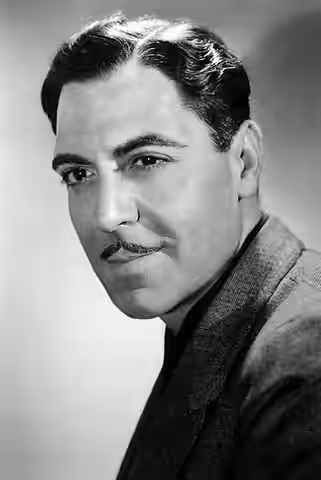
Joseph Calleia spent nearly thirty years being handed the villain, the policeman or the man from somewhere warm, and playing each one as if he had a second thought he was keeping to himself. The studios rarely gave him the lead; he rarely needed it.
Fi1m perspective
Watch a Calleia policeman and you will see him listen. He had dark features and a slight accent, and Hollywood in the 1930s read those as gangster, or as a heavy from some country it did not trouble to name. He took the parts and played them slower and quieter than they were written, so that the man at the edge of the frame seemed to be thinking about something the script had not told him. He said as much in 1936: "I'd like to get away from straight villain roles. But I have no wish to be a hero. I enjoy roles where I get slapped around a bit. It's far more stimulating to play a character that isn't all one thing—not all bad and not all good." Most character actors say that sort of thing. He was one of the few who managed it.
He came to films late and from the stage: Broadway through the 1920s, The Front Page in 1928, Grand Hotel in 1930, and then the gangster in Small Miracle in 1934, his first big villain and the part that brought him an MGM contract. The performances people still go back to are the ones where the badge and the bad conscience sit on the same man. Inspector Slimane in Algiers (1938), Detective Obregon in Gilda (1946), and Sergeant Pete Menzies, the loyal and troubled partner in Orson Welles's Touch of Evil (1958), which is the performance most often called his best. Between them he worked steadily in supporting parts, in film and later in television, and complained that the studios kept sending him the same heavy in a different hat.
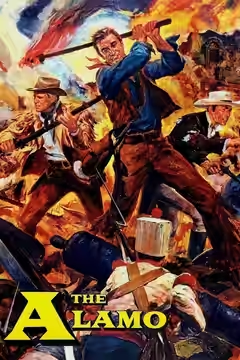
The one film of his we have reviewed shows the other side of that ledger. In John Wayne's The Alamo (1960), 202 minutes of handsome, sincere siege and a good third of it speeches, Calleia plays Juan Seguin. He and Carlos Arruza's Lieutenant Reyes are the only Mexican characters the film treats with any dignity, and they get a scene or two each while Crockett gets the hall. We came out of it annoyed on his behalf. Here was a film with time for every thought Crockett had ever had about liberty, and none to spare for the one man in it who did his thinking without talking.
It was one of his last Hollywood pictures. In 1963 he stopped and went home to Malta. If you want to see what the studios had and mostly spent on gangsters, go to the policemen: Slimane, Obregon, Menzies. He asked for parts where he got slapped around a bit, and he repaid the favour by being the person you watched while the star was speaking.
Biography
Joseph Calleia (born Joseph Alexander Caesar Herstall Vincent Calleja) was a Maltese-born American actor and singer. After serving in the British Transport Service during the First World War, he moved to the United States and began his career on the stage, appearing in Broadway productions including Broadway (1926), The Front Page (1928) and Grand Hotel (1930). He gained attention with the 1934 play Small Miracle and signed a contract with Metro-Goldwyn-Mayer.
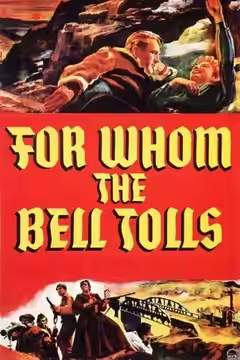
Calleia appeared in numerous Hollywood films from the 1930s to the 1960s, often in character roles as villains or figures of ambiguous nationality. His credits include Algiers (1938), Gilda (1946), Touch of Evil (1958) and The Alamo (1960). He played El Sordo in For Whom the Bell Tolls (1943). He also worked in radio and television, and led the Malta War Relief organisation in the United States during the Second World War. Calleia retired to Malta, where he died in 1975.