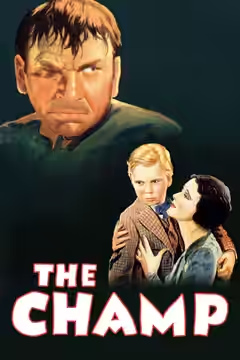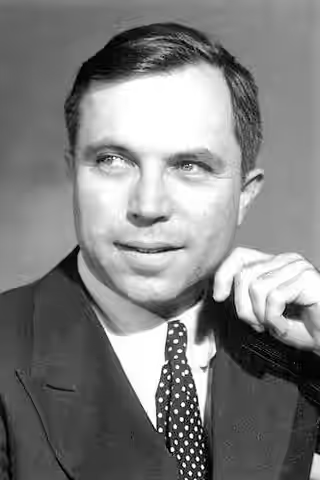
King Vidor changed his style to fit the subject, so nobody can quite say what a Vidor film looks like. What we can say is that, given a good face, he knew to leave the camera on it.
Fi1m perspective
In The Champ (1931) a small boy in a flat cap cries while trying not to, and King Vidor does the thing many directors of the period could not bring themselves to do, which is nothing. The camera stays on Jackie Cooper, in a long take, with Wallace Beery in the same frame, and the scene is allowed to be about a child watching his father. Vidor produced the picture as well as directing it, and there is a producer's economy in it: Frances Marion's story is thin, the sets are Tijuana dust and wooden bars, and it is over in 86 minutes. He once said that "A simple story filmed with limited sets can often be more effective than a costly extravaganza." The Champ is the case for the prosecution.
He had come a long way to that small room. He started as a teenage projectionist in Galveston, made amateur films from 1913, reached Hollywood in 1915 and directed his first feature in 1919. The Big Parade (1925), at MGM, made his name with a war story told from the point of view of the men who fought it. The Crowd (1928) followed one man through a city that did not notice him and is usually called his most personal film. He came through sound with Hallelujah (1929), an all-Black cast shot largely on location, and answered the Depression with Our Daily Bread (1934), a collective farm picture remembered for one rhythmically cut sequence. Then the canvases got bigger: Duel in the Sun (1946), War and Peace (1956), which he also wrote, and Solomon and Sheba (1959), his last major work. Along the way he made three films with Irving Thalberg.
The standing complaint about Vidor is that there is no Vidor. The films do not look like one another, some are uneven, and the late colour pictures were called lurid, Duel in the Sun most of all. We think the complaint is half right. What holds the work together is not a look but a subject: ordinary people, hopes that meet the world and come off worse, the one against the many. And a habit, which is to let the story choose the camera rather than the other way round. In The Champ that means leaving Gordon Avil's largely fixed camera where it stands, and letting Hugh Wynn cut back to Cooper in the corner during the fight so the boy's face tells us how the rounds are going. There is almost no music. We did not expect to be undone by a child talking about a horse, and we were, because Vidor held the shot past the point of comfort and Cooper never once performed for it.
His weaknesses were those of appetite. He wanted the big canvas and the small room both, and it is on the big canvases that critics have found him wanting. We can only judge him here on the small room, and on that evidence he understood in 1931 what a face can carry better than most directors understand it now. Start with the boy and the boxer. Do not be embarrassed when it works.
Biography
King Vidor was an American film director, producer and screenwriter. He was born in Galveston, Texas, on 8 February 1894 and died in Paso Robles, California, on 1 November 1982.
Vidor began working in film in the 1910s and directed his first feature in 1919. His breakthrough came with The Big Parade (1925). Other notable films include The Crowd (1928), Hallelujah (1929), The Champ (1931), on which he also served as producer, Stella Dallas (1937), Duel in the Sun (1946) and War and Peace (1956).
He received five Academy Award nominations for Best Director and was awarded an Honorary Academy Award in 1979.