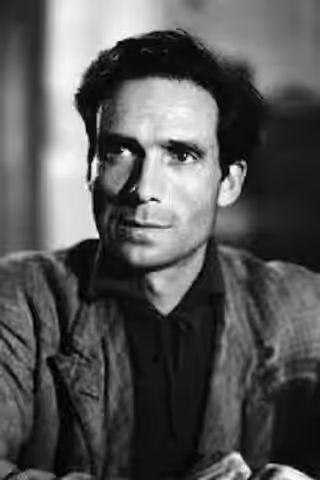
Lamberto Maggiorani makes Antonio’s distress in Bicycle Thieves painfully difficult to watch, without making him a model of dignified suffering. We recommend that performance wholeheartedly; his later, smaller parts never gave him a comparable opportunity.
Fi1m perspective
In Bicycle Thieves (1948), Antonio has to remain a father while his son can see how badly he is struggling. Lamberto Maggiorani makes that responsibility uncomfortable to watch. We felt ashamed of looking so closely at him, because he cannot keep his distress from the child beside him. His awkwardness is what makes the performance so affecting: Antonio never becomes a neatly composed illustration of hardship.
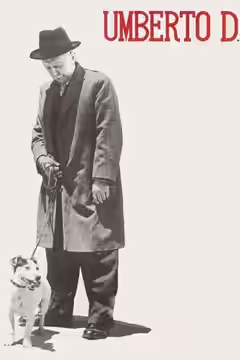
Vittorio De Sica cast him as Antonio from factory work, without formal acting training. The subsequent career brought occasional minor or uncredited roles through the 1950s and 1960s, rather than another opportunity on that scale. He appeared uncredited in De Sica’s Umberto D. (1952), then had a bit part as the Sick Man in Pier Paolo Pasolini’s Mamma Roma (1962). These are not grounds for inventing a story of steady artistic development. Nor should smaller roles be taken as evidence that the first performance was a fluke.
The work with De Sica gives us plenty to consider on its own. It is tempting to assume that a factory worker needed only to appear before the camera to make Antonio convincing. That overlooks what happens when Enzo Staiola’s Bruno watches him: Antonio’s distress becomes harder to bear because his child is taking it in. De Sica’s pairing of the two gives the search for the stolen bicycle much of its force.
Not every choice around them helps. Alessandro Cicognini’s score sometimes adds a sweetness that presses too hard on suffering already clear in the performances. Placing a child beside Antonio also risks making Bruno little more than a means of increasing our pity, though Staiola largely prevents that. We would turn the music down before asking Maggiorani to do anything differently. Watch Bicycle Thieves for the two actors, and allow for the unnecessary prompting.
Biography
Lamberto Maggiorani was an Italian actor. He is best known for his portrayal of Antonio Ricci in Vittorio De Sica's Bicycle Thieves (1948). A factory worker and non-professional actor at the time of casting, he had previously worked as a turner.
Following the film's success, Maggiorani faced difficulties returning to his previous employment and took occasional work as a bricklayer while pursuing further acting roles with limited success. He appeared in small or uncredited parts in films including Umberto D. (1952), Mamma Roma (1962) and We All Loved Each Other So Much (1974). He died in Rome on 22 April 1983.