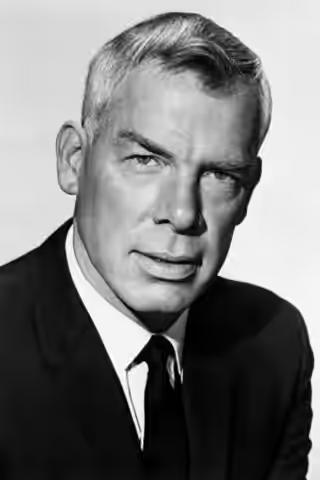
Lee Marvin spent a decade as the man you hoped the hero would shoot, then a decade as the hero. The gravel voice and the white hair did the menace; what stays with us is the sadness he let show around it.
Fi1m perspective
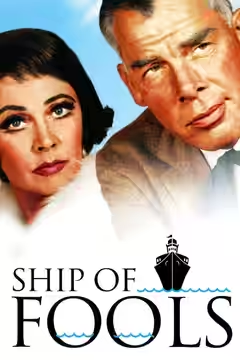
A Lee Marvin character tends to tell you what he is before he does anything. Tenny in Ship of Fools (1965) is a ballplayer who could never hit a curve and says so to anyone at the rail who will stand still; the gangsters of his early years announce themselves by the way they fill a doorway. The voice is gravel, the hair went white early, and the body is always a size too large for the furniture around it. He was typecast as a heavy for years, and he seems to have decided that if that was the job, he would do it properly.
The villains came first. Vince Stone in The Big Heat (1953) fixed the persona, The Wild One the same year confirmed it, and Liberty Valance in John Ford's The Man Who Shot Liberty Valance (1962), opposite John Wayne and James Stewart, gave him the part most people still picture when they hear the name. Television paid the bills in between, with a lead in M Squad (1957–1960). Then Cat Ballou (1965) let him play two parts in one western spoof, and the joke landed well enough to make him a leading man. From there it was Major Reisman in The Dirty Dozen (1967) for Robert Aldrich, Walker in Point Blank (1967), and a long run of action films and westerns that kept him working until The Delta Force (1986).
Ship of Fools is the one we have looked at most closely, and it is instructive because he is not the point of it. Stanley Kramer has Vivien Leigh, Simone Signoret and Oskar Werner on board, and Marvin has the least glamorous part. We felt sorrier for Tenny than Mann's script asked us to, because Marvin plays the boasting as a man who has noticed nobody is listening and cannot stop anyway. We called the performance coarse and sad and better than the film deserved, and we stand by all three. That sadness under the bluster is worth watching for in the tougher parts too; it is the thing that separates him from the men who copied the walk.
Not everything he tried suited him. He sang in Paint Your Wagon (1969), and opinion of the singing has not softened with time. The 1970s brought a run of lesser films after the peak, which is the usual shape of a star's second decade and no disgrace. Samuel Fuller gave him a late lead as the Sergeant in The Big Red One (1980), a war film Fuller built from his own service, and it is the last of the big ones.
He once said, "Only reason I ever had to be an actor was that I wasn't tough enough to be a criminal." On the evidence of The Big Heat, he was underselling himself. If you want to see what he did with a small part in a crowded room, start with Ship of Fools, and watch him while the others are talking.
Biography
Lee Marvin was an American actor. He served in the United States Marine Corps during the Second World War before studying at the American Theatre Wing and beginning his career in stage and television productions.
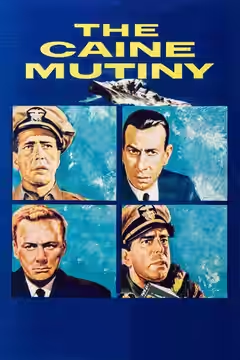
Marvin appeared in supporting roles in films including The Big Heat (1953), The Caine Mutiny (1954) as Meatball, and Bad Day at Black Rock (1955). He gained prominence with the television series M Squad (1957–1960) and lead roles in The Killers (1964), The Professionals (1966), The Dirty Dozen (1967) and Point Blank (1967). He won the Academy Award for Best Actor, a BAFTA Award and a Golden Globe Award for his dual performance in Cat Ballou (1965). Later credits include The Big Red One (1980) and The Delta Force (1986).
Marvin died in 1987.