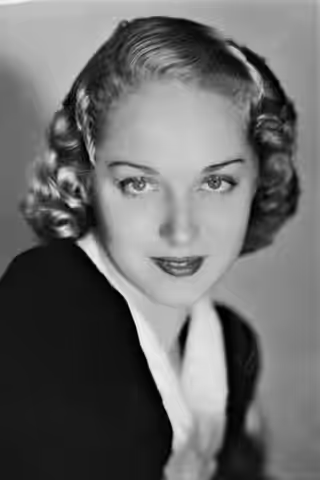
Leila Hyams was the pleasant, sensible woman a studio put into a picture to prove it had one, and she did the job without fuss. She is remembered for the two horror films of 1932 that found a use for her, and she left early.
Fi1m perspective
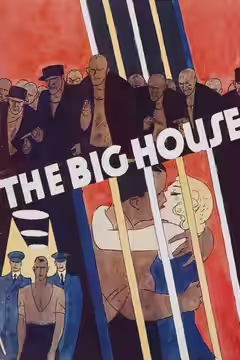
Halfway through The Big House (1930) the film steps outside the prison and there is Leila Hyams, as Anne Marlowe, the sister of Robert Montgomery's Kent. She is lit flatter than the men in the cell block, played slower and written softer, and she is asked to fall in love on a schedule. She does it pleasantly. Watching those scenes we were less bored than sorry for her: the film goes dead the moment it reaches her, and nothing she does is the cause. Someone had decided a prison picture needed a woman in it, and she was the woman.
That was the part she was given more often than not. Hyams came out of vaudeville, where she spent five years in her parents' act, and went into films in 1924, in silents. She crossed into sound without trouble, starring as Rose in Alias Jimmy Valentine (1928), MGM's first talkie, and through the early 1930s she was the natural, down-to-earth one: the sympathetic sister, the decent fiancée, the nice girl the plot returned to between its more interesting scenes. She worked across prison drama, comedy and pre-Code pictures, Red-Headed Woman among them, and she was, by every account, easy to like and easy to overlook.
The exception, and the reason anyone still looks her up, is 1932. That year Tod Browning cast her as Venus, the kind-hearted circus performer in Freaks, and she played Ruth Thomas, the heroine of Island of Lost Souls, opposite Charles Laughton and Bela Lugosi. We have not reviewed either, so we will not weigh them here, but her reputation rests on them, and it is worth noticing why. The horror film needs one ordinary person to stand among the monsters and stay kind, and it finally had a use for exactly what she did. The nice girl was not filler there. She was the point.
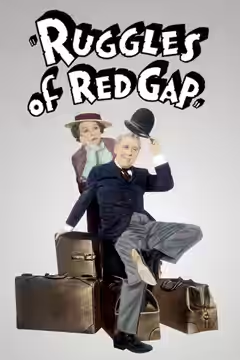
Three years later she was back with Laughton in Ruggles of Red Gap (1935), as Nell Kenner, in a comedy we liked a great deal and about which our review does not mention her at all. That is the honest measure of a career like hers: she was in good films and she did not get in their way. She retired from features in 1936 after twelve years and about fifty pictures, and she said later that she 'never developed the driving ambition which you really need if your goal is stardom'. Most actors who say that are consoling themselves. Watching her, we believe her, and we suspect the studios could tell.
Biography
Leila Hyams was an American actress. Born in New York City, she came from a show business family; her parents were vaudeville performers John Hyams and Leila McIntyre.
Her film career began in silent pictures in 1924 and continued into the sound era until 1936. She appeared in more than 50 films, including Spite Marriage (1929), The Big House (1930) as Anne Marlowe, Freaks (1932), Island of Lost Souls (1932), Red-Headed Woman (1932) and Ruggles of Red Gap (1935). She was married to talent agent Phil Berg from 1927 until her death.