Leni Riefenstahl used cutting and music to make obedience look pleasurable. We recommend Triumph of the Will for critical study, but its technical skill does not make the relentless insistence any less exhausting.
Fi1m perspective
In Triumph of the Will (1935), the cutting makes one ceremony seem to confirm the importance of the next. Movement and music keep agreement going until an interruption feels almost impossible. We were repelled by its treatment of obedience as a public pleasure, and worn down by the repetition. Its propaganda deserves study because Riefenstahl's choices are so legible: we can see how an image of unquestioned authority is assembled.
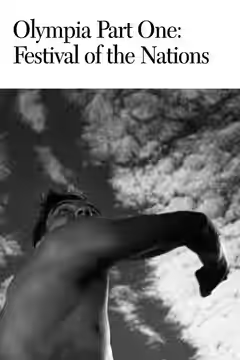
Her first feature as director was The Blue Light (1932), followed by the rally film Sieg des Glaubens (1933) and then Triumph of the Will. With Olympia (1938), her two-part film of the 1936 Berlin Olympics, athletic movement became the subject of her attention to strength, beauty and rhythm. Multiple cameras and varied angles helped her organise sporting events into precisely composed sequences. Across this work, she favours idealised bodies and orderly formations, giving us little encouragement to look beyond their physical perfection.
That control is clearest in Triumph of the Will, which she produced, directed and edited. Herbert Windt's music sustains the ceremonies' momentum, but its insistence is wearing, especially when the cutting keeps pressing the same point. Riefenstahl's wider methods included moving cameras on tracks, cranes and lifts, alongside low angles that made figures look heroic. Cinematographers Walter Frentz and Hans Ertl were among her collaborators, though much of the persuasion happens in the edit, as movement and ceremony are made to reinforce each other. Across the film's 114 minutes, we miss any pause that might allow a different response.
After Tiefland (1954), completed following wartime interruption, her work turned towards photography and eventually underwater filming. The Nuba photographs from 1973 continued her interest in idealised bodies; Impressionen unter Wasser (2002) belongs to the later underwater work. For an introduction, give Triumph of the Will the time to stop and examine the cuts. It is poor company for a relaxed evening.
Biography
Leni Riefenstahl was a German film director, producer, screenwriter and editor. She directed, produced, wrote the screenplay for and edited the 1935 documentary Triumph of the Will.
Born Helene Bertha Amalie Riefenstahl on 22 August 1902 in Berlin, she began her career as a dancer and actress in mountain films before directing her first feature, The Blue Light (1932). She is also known for directing the two-part film Olympia (1938), documenting the 1936 Berlin Olympics.
After the Second World War her directing career in feature films ended. She later worked as a photographer, publishing books including The Last of the Nuba (1973). She died on 8 September 2003.