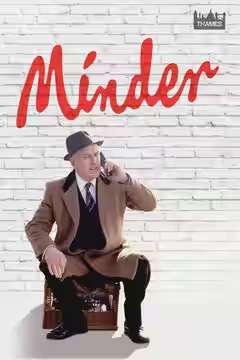
Leon Griffiths wrote crime for the pictures for twenty years and then, with Minder, found the trick of making a crook likeable without making him harmless. The series outlived his interest in it, which is the best evidence of how sturdy the idea was.
Fi1m perspective
Arthur Daley has something in the lock-up he would like you to have, and Terry McCann is standing just behind him in case you decline. That is the whole of Minder (1979), and Leon Griffiths built it. He had pitched a tougher crime series in the manner of The Sweeney, and he put in the pitch that "a leavening of humour is essential". The humour turned out to be the part everyone remembered.
He came to television from newspapers and spent the 1960s and 1970s as a working screenwriter of crime and horror: a Burke and Hare picture, The Flesh and the Fiends (1960), The Grissom Gang (1971) for Robert Aldrich, The Squeeze (1977) for Michael Apted, and episodes of Play for Today. We have not reviewed those and will not pretend to a view of them here. What they show is a writer who knew the furniture of the genre well enough to rearrange it, which is what he did when Minder turned the private-eye plot into a story about a bodyguard and the man who cannot afford him.
The material came from north London drinking clubs, where Griffiths sat and listened to what he called semi-villains. "They lived on their wits and were great storytellers," he said. "I don't suppose half of what they said was true but it didn't matter." That is Arthur Daley exactly: George Cole gets the voice, but Griffiths supplied the logic, the way a loss becomes an investment and a lie becomes a kindness between friends. We found ourselves fond of Arthur against our better judgment, which is the trick of the writing; the terrible things he says are phrased as advice, and Dennis Waterman's Terry takes the punches so that we never have to see the cost.
It is not a deep show, and we have said so. The scripts run to a formula, and the years without Waterman are thinner. Griffiths wrote the early episodes and then stepped back as the series moved further into comedy than he had wanted, and he was not happy about where it went. Yet the voice held. Tony Hoare, Andrew Payne, Paul Wheeler and the others kept writing in his register across 108 episodes and ten series, under directors as various as Roy Ward Baker and Martin Campbell, and the result still sounds like one man's idea of how people in that world talk.
Watch the early series, where the jokes still have a bruise under them. That is Griffiths at his most present, and it is where the series earns the score we gave it.
Biography
Leon Griffiths (15 February 1928 – 10 June 1992) was a British television and film screenwriter. Born in Sheffield, he grew up in Glasgow. After national service with the British Forces Network, he worked as a journalist for the Daily Worker.
His early screen credits include scripts for The Adventures of Robin Hood, The Four Just Men and Play for Today. Film work includes The Grissom Gang (1971), The Hellfire Club (1964), The Treasure of Monte Cristo (1964) and The Squeeze (1977). In 1979 he created the long-running ITV series Minder, for which he also wrote numerous episodes. He received the BAFTA Television Writers Award in 1985.