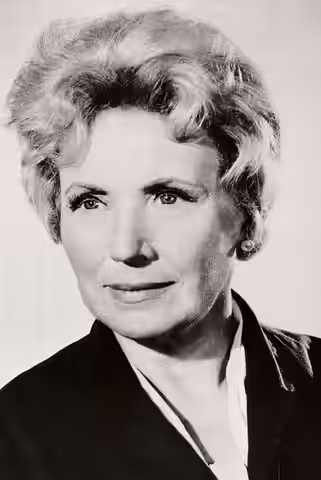
Lilia Skala played authority without ever raising her voice, and made the quiet feel like the stronger position. Her screen career is nearly all supporting parts, but Mother Maria in Lilies of the Field is one worth an evening on its own.
Fi1m perspective
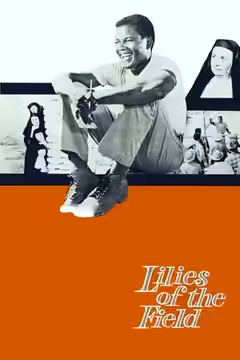
Homer Smith has fixed the roof and stands beneath it waiting to be thanked. Mother Maria thanks God instead, out loud, in front of him, so that he cannot claim it. That is Lilia Skala's method in one scene: she never raises her voice, never concedes a point, and never lets the other person see her enjoying it. In Lilies of the Field (1963) she plays a woman who is wrong about wages, wrong about manners and right about everything that counts. Poitier plays Homer as a man who wants his competence acknowledged. Skala plays a woman who has no intention of acknowledging it, and the film is the ninety-four minutes it takes him to realise that.
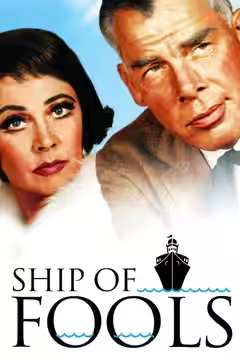
She came to this late. Skala trained as an architect in Dresden before she was an actor, worked in Max Reinhardt's company in Austria, fled in 1939 and made her Broadway debut in 1941. Film did not start until 1953, and the part that made American cinema notice her arrived when she was in her late sixties. After it the offers were of a kind: Frau Hutten in Ship of Fools (1965), Dr Anna Straus in Charly (1968), which reunited her with Ralph Nelson, Hanna Long in Flashdance (1983), Dr Maria Littauer in David Mamet's House of Games (1987). Nuns, doctors, immigrant elders. The stern face and the Viennese accent, hired again and again to be the grown-up nobody dared contradict.
What works is the pragmatism. Most actors playing faith on screen play serenity; Skala plays a woman running a budget. Mother Maria wants a chapel and has no money, and she never lets anyone forget which of those facts she considers the more important. The architect shows: she is the one who knows what the building will cost and has decided to build it anyway. We wanted Homer to win one argument, just one, and were a little ashamed to find ourselves pleased each time he lost, because she made losing to her feel like being taught something. That is hard to bring off without a raised voice, and she does it for the whole film.
What does not work is around her rather than in her. A late breakthrough in a habit and an accent is a trap, and the parts that followed did not often ask for more than the manner that made her. We have not reviewed the later films and will not judge them at length, but the run of titles tells its own story. The film she is best known for is also slighter than she is: our review found it a little too pleased with how easily everyone gets along, and Skala's refusal to be pleased about anything is the main thing that keeps it honest.
Start with Lilies of the Field. If the sight of an old woman losing every point and taking the trick anyway does something for you, the doctors and matrons are there afterwards, and she was reliable in them, which is a smaller compliment than she deserved.
Biography
Lilia Skala (née Sofer) was an Austrian-American actress and architect. Born in Vienna in 1896, she trained in architecture at the Technische Hochschule Dresden and became one of the first women to practise the profession in Austria, as well as the first female member of the Austrian Association of Engineers and Architects. She fled Nazi-occupied Austria with her family in 1939 and settled in the United States, where she worked in various jobs before resuming her stage career.
Skala appeared in films from the 1950s onwards. She received an Academy Award nomination for Best Supporting Actress and a Golden Globe nomination for her role as Mother Maria in Lilies of the Field (1963). Other film credits include Ship of Fools (1965), Charly (1968), Flashdance (1983) and House of Games (1987). She also worked extensively in television, with recurring roles in Green Acres and appearances in series such as The Alfred Hitchcock Hour and Ironside.