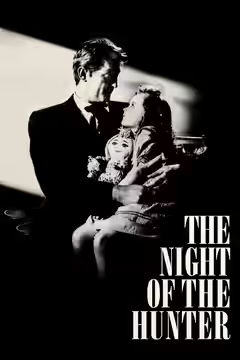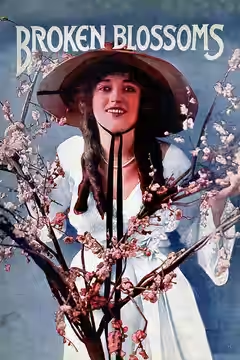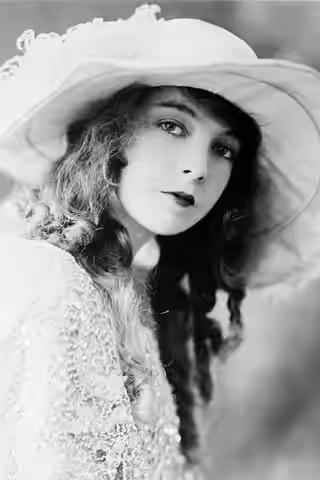
The face of silent cinema, and among the first actors to understand that a close-up wants less, not more. Her heroines suffered for Griffith through the 1910s and 1920s; her best late part, Rachel Cooper in The Night of the Hunter (1955), refuses to.
Fi1m perspective
She does very little and the camera does the rest. Lillian Gish's habit, from the Griffith years on, was to hold still in close-up and let a thought arrive on her face rather than act it out, at a time when most screen acting was stage acting done nearer the lens. Her heroines were fragile, innocent or suffering, usually all three, and the suffering was often real: for Way Down East (1920) she went out onto the ice and into the cold and stayed there. Griffith himself, by her account, gave up trying. "He didn't direct me. He said: 'It doesn't matter. She'll do what she pleases anyway.'"
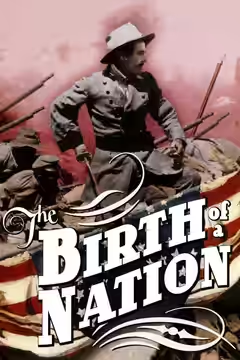
The career has three parts. There is the Griffith period, more than sixty films between his shorts at Biograph in 1912 and Orphans of the Storm (1922), taking in The Birth of a Nation (1915), which made her a star and has been argued over ever since for what it says, Broken Blossoms (1919) and Way Down East. There are the late silents away from him, including two films with Victor Sjöström and The Wind (1928), her last major silent role and, on most accounts, one of her strongest. Then there is the long third act: supporting parts in sound films from the 1930s, a good deal of stage work in the thirties and forties, and character parts on film and television into the 1980s. Her sister Dorothy was beside her for some forty of those films.
Some later critics have found the silent Gish excessive by the standards of talking pictures, and we understand the objection without sharing much of it. The films around her are often broad. She rarely is. What has dated is the melodrama, not the woman standing still in the middle of it.
The reason to watch her now is The Night of the Hunter (1955). Charles Laughton opens his only film as director on Gish telling a Bible story to a ring of children under a sky full of stars, and brings her back late as Rachel Cooper, an old woman with no patience for a man in a good suit. He uses her as what she had been, the face of silent cinema, all eyes and set jaw, and puts that face opposite Robert Mitchum's preacher. It moved us more than we were ready for, and the reason is plain: for twenty years that face had been asked to be afraid, and here Laughton asks it to be the one thing in the film that is not.
Start there; it is the one film of hers we have reviewed, and it needs no allowances made for it. Then go back to the Griffiths and the Sjöströms and make the allowances. She is worth them.
Biography
Lillian Gish was an American actress whose film career spanned from 1912 to 1987. She was born Lillian Diana Gish on 14 October 1893 in Springfield, Ohio, and died on 27 February 1993 in New York City.
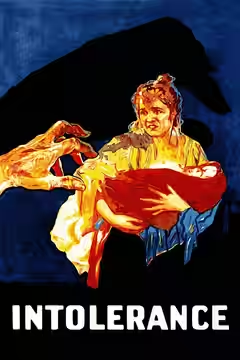
Gish began her career on stage before entering films. She appeared in numerous silent films directed by D. W. Griffith, including The Birth of a Nation (1915) as Elsie Stoneman and Intolerance (1916). Her later roles included Rachel Cooper in The Night of the Hunter (1955), Mattilda Zachary in The Unforgiven (1960), and her final film appearance in The Whales of August (1987). She also worked extensively in television from the 1950s onwards.
Gish received an honorary Academy Award in 1971 and the American Film Institute Life Achievement Award in 1984.