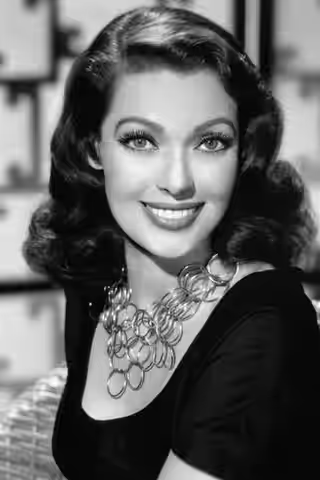
Loretta Young made a career out of being the well-behaved woman in the good frock, and did it with more control than her early critics credited. It is a small, careful talent; the one film of hers we have written up finds it stranded in a doorway.
Fi1m perspective
For eight years of television Loretta Young came through a door. The gown was different every week and the turn was the same, a swirl of skirt before she said a word, and the point was that you had looked at her before you had listened. She knew exactly what the entrance was for. "After the audience has seen me well groomed," she said, "I can wear horrible clothes and ugly makeup or even a false nose, without anyone wondering whether I've aged overnight." That is as clear a statement of a screen method as any actor has given: be beautiful first, and the rest is permitted.
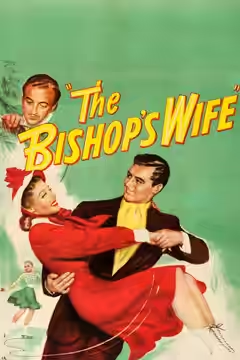
The method was formed early. Young was a child extra in 1917, played in silents as a teenager, and was a lead by the late 1920s, opposite Lon Chaney in Laugh, Clown, Laugh (1928). The 1930s were steady work at Warner Bros. and Fox, much of it in costume, and the parts were of a kind: refined, virtuous, a little fragile, with a spine somewhere underneath. Critics of the day mostly took her for a pretty blank. The reputation turned in the late 1940s, with The Farmer's Daughter (1947), in which she plays a Swedish maid who goes into politics and is convincing in the accent, and The Bishop's Wife (1947), a fantasy comedy with Cary Grant and David Niven in which she is the poised wife of the title. The Stranger (1946) put her in a thriller directed by Orson Welles; Come to the Stable (1949) put her in a nun's habit. She left features in 1953 and went straight to the door and the gowns.
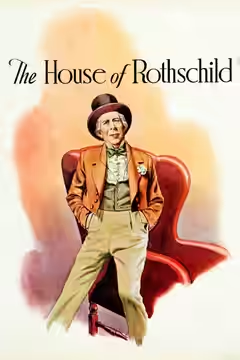
Our one film is the early kind. In The House of Rothschild (1934) she is Julie, Nathan's daughter, in love with Robert Young's Captain Fitzroy and forbidden him by her father's rules. The writing gives the pair nothing to do but look pained in doorways, and she looks pained in them with great poise, which is the problem. We watched those scenes waiting for her to want something badly enough to spoil the composure, and she never does, and we found we did not much mind whether she got him. George Arliss carries the film; the romance is what you sit through to get back to him. It is a small part and no fair measure of a career, but it shows the habit her sterner critics described: a reluctance to be anything other than sympathetic, which in a thin part leaves nothing at all.
The case for Young rests on the late 1940s, which we have not yet written up and will not judge here beyond saying that a maid with a Swedish accent standing for office is the kind of part that asks something of an actress, and she is said to have answered. Start there rather than with the 1930s costume pictures, where she has less to do. And if you can find the television, watch the door.
Biography
Loretta Young was an American actor. Born Gretchen Michaela Young, she began her career as a child extra in films from 1917 and appeared in her first credited role at age 14 in Naughty but Nice (1927). She transitioned successfully to sound films and became a leading lady in Hollywood.
Young is known for roles including Claire Blake in Call of the Wild (1935), Mary Longstreet in The Stranger (1946), Julia Brougham in The Bishop's Wife (1947) and Katrin Holstrom in The Farmer's Daughter (1947), for which she won the Academy Award for Best Actress. She received a further nomination for Come to the Stable (1949). She retired from feature films in 1953.
From 1953 to 1961 Young hosted the anthology series The Loretta Young Show, appearing in many episodes; the programme won three Emmy Awards. She later worked with Catholic charities.