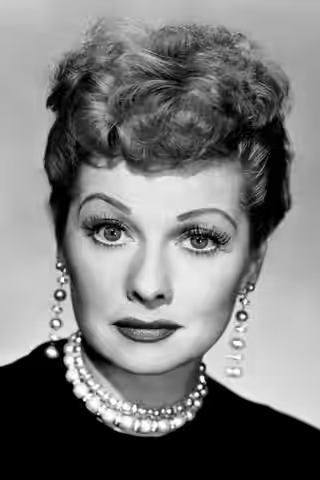
The best-known face in American television comedy spent the 1930s and 1940s in Hollywood being overlooked. What she had was timing, nerve and a willingness to fall over for a living, and it took a studio audience to make anyone see it.
Fi1m perspective
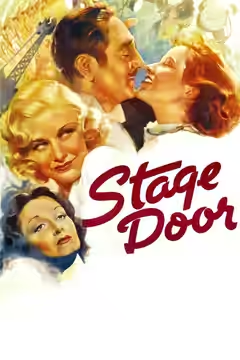
In Stage Door (1937), Lucille Ball plays Judith, one of a boarding house full of out-of-work actresses, and her whole part is waiting. She is waiting for a lumberman called Butch, played by Grady Sutton, and while Katharine Hepburn and Ginger Rogers get the shared bedroom and the argument, she gets her laughs by being drier about her situation than anyone else in the film. We were struck, watching it again, by how little she does. The woman who would later make a career of falling off things is here doing the least of anyone in the house, and it works.
Hollywood kept her busy and never worked out what she was for. She came in as a model and a bit player, spent years under contract at RKO in supporting parts, and picked up the nickname Queen of the B's, which is not a compliment anyone asks for. Dance, Girl, Dance (1940), as Bubbles for Dorothy Arzner, is the other early part worth knowing. Then, in 1951, came I Love Lucy, made with her husband Desi Arnaz through their own company, Desilu, and Lucy Ricardo, the scheming housewife whose face did most of the talking. It ran until 1957. The Lucy Show (1962 to 1968) and Here's Lucy (1968 to 1974) followed, and the one substantial late film part, Yours, Mine and Ours (1968).
What she did on television was slapstick in the vaudeville line, and she did it with two things most comedians lack: exact timing, and no visible fear of the gag going wrong on her body. She and Arnaz filmed I Love Lucy with three cameras in front of a live audience, a set-up built so that the laughs on the soundtrack were the laughs in the studio. She said it herself: "I am a real ham. I love an audience. I work better with an audience. I am dead, in fact, without one." Vivian Vance opposite her, and Madelyn Pugh Davis and Bob Carroll Jr writing, gave her the routines; the crowd gave her the reason to do them properly.
The caveat is the films, and it is not really her fault. The 1930s and 1940s pictures got little notice at the time and they are not where her reputation lives now. But the dry, patient Judith of Stage Door is a different performer from the one the sitcoms built, and Hollywood had her for the better part of two decades without finding a use for that quality either.
If you know her only from the television, start with Stage Door. It is ninety minutes with the one version of Lucille Ball that nobody ever built a show around.
Biography
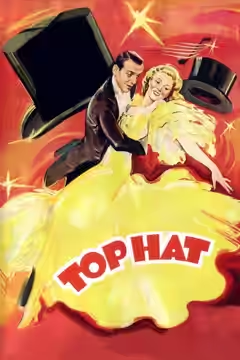
Lucille Ball was an American actor. She was born on 6 August 1911 in Jamestown, New York, and died on 26 April 1989 in Los Angeles, California. Ball began her career as a model under the name Dianne Belmont before appearing in small film roles in the 1930s as a contract player for RKO Radio Pictures. Her early credits include an uncredited role as Flower Shop Clerk in Top Hat (1935).
She is known for her work in films such as Stage Door (1937), Room Service (1938), Dance, Girl, Dance (1940), Lured (1947) and Yours, Mine and Ours (1968). Ball starred as Lucy Ricardo in the television series I Love Lucy (1951), which also featured Desi Arnaz. She later appeared in The Lucy Show (1962) and Here's Lucy (1968).
Ball received four Emmy Awards from thirteen nominations. She was awarded the Golden Globe Cecil B. DeMille Award in 1979 and the Kennedy Center Honors Lifetime Achievement Award in 1986.