Luise Rainer made a handful of Hollywood films and is remembered for one telephone call. She acted from the inside and let all of it show on her face, which is thrilling in a single shot and can wear over a whole picture.
Fi1m perspective
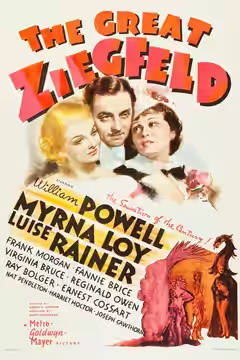
Late in The Great Ziegfeld (1936), Anna Held picks up a telephone and congratulates a man on his happiness. Her voice holds. Her face does not. Robert Z. Leonard keeps the camera on her and lets her do it in one shot, and Luise Rainer laughs and cries at the same time without either winning. It moved us more than the film had earned; it is a slack three hours and she is in a corner of it, and she walks off with the whole thing on the strength of a receiver and a smile that will not stay put.
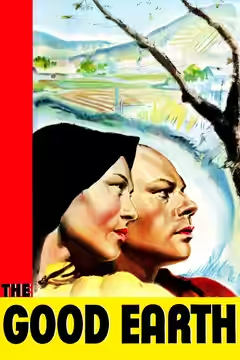
That call is what people still talk about, and fairly, because it is the clearest example of what she did. She came up on the German-language stage, in Max Reinhardt's company from her late teens, and arrived at MGM in 1935 with her technique already formed. Escapade (1935), opposite William Powell, made her a star. The Great Ziegfeld gave her Anna Held, a Parisian in a tower of curls, vain and quick to tears. The Good Earth (1937) then sent her as far from Anna as the studio could manage, as O-Lan, a stoical Chinese peasant wife. After that she fell out with MGM over the parts it offered her, and by the early 1940s she had more or less gone. Hostages (1943) is one of the few features from a long and sparse afterwards. She settled in London and died there in 2014.
She was plain about her method. "I worked from inside out. It’s not for me, putting on a face, or putting on makeup, or making masquerade. It has to come from inside out." You can see it. Nothing is held back; every feeling comes to the surface and stays there long enough to be read from the back of the stalls. In a short scene that is a gift, and the telephone call is the proof. Over two hours it becomes a habit the eye starts to notice, and later critics who found her mannered, more stage than screen, were not wrong. What saves her in Ziegfeld is that she has something to push against. Adrian dresses Anna as an ornament Ziegfeld has ordered rather than met, and Rainer plays her as shrewder than the men around her, which is the smartest choice anyone makes in the film.
She worked in Hollywood for a few years and left when the parts stopped being worth the trouble, which is a rarer decision than it sounds. Watch the telephone call; it takes about two minutes and needs no context we would spoil by giving it. The rest of the film is optional. She, for those two minutes, is not.
Biography
Luise Rainer was a German-born actress. Born on 12 January 1910 in Düsseldorf, Germany, she died on 30 December 2014 in London.
She began acting at the age of 16 and trained with stage director Max Reinhardt in Vienna and Berlin. After appearing in German-language films, she signed with MGM and moved to Hollywood in 1935.
Rainer won consecutive Academy Awards for Best Actress, first as Anna Held in The Great Ziegfeld (1936) and then as O-Lan in The Good Earth (1937). She later lived in London and held German, American and British citizenship.